A DEFINITION
The Greek word ANASTASIS meaning a rising up, a standing up (from the root ANISTEMI, to stand up, to cause to rise) is used 42 times in the New Testament and is translated 39 times 'resurrection', once 'rising again', once 'raised to life again', and once 'that should rise'.
Resurrection is therefore the standing up of dead ones. The resurrection will be a virtual re-creation of former beings into exactly the same mental, moral, and physical state that they possessed prior to their death.
The apostle Paul deals at length with the subject of resurrection in 1 Cor. 15 and this discourse along with the symbolic enactment of Daniel's resurrection recorded in Dan. 10 will form the basis of the following notes.
PAUL'S DISCOURSE ON RESURRECTION - 1 Cor.15:35-54
The apostle sets out to answer some in the Corinthian ecclesia who denied the doctrine of resurrection altogether. He refutes their arguments in this section and in the process demonstrates the whole process of resurrection up to its final objective - the incorruptible, glorified being. He reveals that this final state is one of 'difference with identity', i.e. the glorified individual with an immortal body will retain his basic physical form, individual identity, character and moral attributes.
V.35 — "How are the dead raised up" - Bro. Thomas translates, "How are the dead ones rebuilded". The word 'raised up' being EGEIRO signifies to awaken, wake up, arouse, cause to rise up and in the passive voice, to rebuild, rear up, to cause to exist.
"and with what body do they come" - Bro. Thomas translates, "and for what body do they conie forth". The word 'with' should be translated "to" or "for". Paul anticipates the question of his detractors. The question is - for what purpose are they raised? Will they remain as they are after the resurrection? What body will they assume when 'rebuilding' is completed?
V.36 - "Thou fool" - An exclamation as translated by Rotherham, "simple one", and the Diaglott, "O senseless man". The word 'fool' is APHRON - without mind, senseless, destitute of any sound principle. Paul is moved to thus rebuke his detractors because even nature itself taught them the principles of resurrection.
"that which thou sowest" - SPEIRO (active voice) to scatter seed, to sow seed. It is important to note that while the apostle likens the sown seed to the dead body being laid in the ground, his emphasis is not upon the dead body or its dissolution but upon the new body which springs forth at the resurrection. This is in keeping with the anticipated question he has asked in verse 35 - "tο or for what body do they come forth?" The apostle's mind is rivetted firmly on the issue which confronted him in Corinth - is bodily resurrection fact or fable? Some in Corinth thought it to be fable because their Hellenised minds could not understand how it was possible for a man to be raised after centuries of dissolution into a being identical with his former self, mentally, morally, and physically, but the philosophers of Corinth had not even considered the natural phenomena of sowing grain which clearly illustrated the principles involved and testified to its possibility in the human sphere.
"is not quickened except it die" - The word 'quickened' is ZOOPOIEO - to make alive, to give life. This is a direct reference to the words of Christ in John 12:23-26. The principle of nature is that new life is preceded by death of the original seed body - so it is also in the human sphere, both in a physical and spiritual sense.
THE TERMS 'SOWN' AND 'RAISED' AS USED IN 1 CORINTHIANS 15:36-52
There are a number of views current on the meaning of the phrase "It is sown" used by the apostle in 1 Cor.15:42-44. The principal suggestions are:-
1. That we are 'sown' when we are born into a state and an environment related to corruption, dishonour, weakness, and to things natural. This 'sowing' is said to cease at death and is followed by a resurrection and a 'raising' process which ultimately leads to immortality and incorruptibility. Paul's words are compared with the parable of the Sower and the Lord's reference to "a corn of wheat" in John 12:24-26 in order to show that 'sowing' in the life of a believer is actually a 'dying' process - "I die daily' – 1 Cor.15:31.
2. That we are 'sown' when our dead body is placed in the ground after the pattern of sowing grain in the cultivated earth.
3. That we are 'sown' when we are called forth from the grave at the resurrection of the dead.
A critical examination of the three views
View 1. — While this interpretation of the phrase "it is sown" answers some apparent difficulties in 1 Cor. 15 and clearly sets forth the scriptural teaching in respect to sowing and reaping in the Truth it nevertheless fits very uncomfortably into the context of Paul's discourse on resurrection. How are we to reconcile this view that 'sowing' relates to life and probation with the introductory sentence of 1 Cor.15:42 - "So also is the resurrection (ANASTASIS standing up) of the dead"? This sentence forms the bridge between v.38 and v.42 which are divided by a parenthetic expansion of the phrase "and to every seed his own body", v.38. Paul's subject is quite clearly resurrection of a dead body not the life and probation of a living being. He is expounding the question "How are the dead raised up? And 'to' or 'for' what body do they come forth?" (v.35). Any interpretation of the phrase "it is sown" must therefore be consistent with that theme and this interpretation simply cannot be made to fit the context.
View 2. - The objection advanced against this view is that Paul says in 1 Cor. 15:44, "It is sown a natural body" and uses the words PSUCHIKON SOMA meaning a living body. This automatically rules out the possibility of reference to the burying of a dead carcase. This is correct in respect to the context of Vv.42-44 but it is not valid in respect to v.36. The reason for this lies in the different voice of the word 'sown' used by the apostle. In verses 36 and 37 the word SPEIREIS is used and is in the active voice meaning the act of scattering and sowing seed. However, in verses 42-44 the word SPEIRET- AI is used and is in the passive voice. Depending on the context this word relates not so much to the act of sowing but the results of sowing, hence Bro. Thomas translates it, "it springs forth" in reference to the sprout body of a planted seed. (See under the word SPEIRO in the Greek-English Lexicon by Liddell and Scott). The context requires us to accept this meaning. Bearing in mind that verses 39-41 are virtually a parenthetic statement, verse 42 can be read immediately following verse 38 where the context clearly refers to the sprout body - the first visible sign of sowing; the emergence from the ground of a new plant. Therefore, the apostle likens the sowing of seed to the burying of the dead body in verses 36 and 37 and goes on to employ the simile of its sprouting forth from the ground in the context of the resurrection of the body. Having developed his theme to this point the apostle then says, "So also is the resurrection of the dead. It springs forth in corruption...." The 'sowing' of v.42 therefore relates to the newly resurrected body as it comes forth in a state of corruption, dishonour, weakness, and natural life.
View 3. - This is the view advanced by Dr. Thomas in his work "Anastasis" (1866) and is based upon the meaning of the word 'sown' in verses 42-44 explained above in View 2. The only objection raised against this view has been that at resurrection believers are 'reaped' not 'sown'. That is true, but such an argument fails to take into account either the variation in meaning of the word SPEIRETAI used in the passive voice or the demands of the context. If the meaning of the word provided by Dr. Thomas is accepted, and some notable Lexicographers do support his interpretation, then the weakness and invalidity of this objection immediately appears. Paul is speaking about the 'springing forth' of the resurrected body and such terminology undeniably relates to the resurrection.
'RAISED INCORRUPTIBLE' - 1 Cor.15:52
Two very diverse interpretations have been placed upon this phrase.
They are:-
1. That the dead are resurrected with incorruptible bodies, i.e. they come forth from the grave immortal. This doctrine is commonly known as 'immortal emergence'.
2. That the dead are 'raised', 'reared up', 'rebuilt', and 'caused to exist’ by a process in stages to ultimate incorruptibility.
An examination of the two interpretations
Interpretation 1. - This doctrine does away with the judgement of the "just and unjust" before the tribunal of Christ; leaves responsible but unworthy saints and accountable sinners in the grave, and does similar violence to many other doctrines of the "one faith". The apostle does not say, "The dead are resurrected incorruptible", but "the dead are raised incorruptible". Everything hinges on the word 'raised' and investigation shows that it must not be confused with ANASTASIS or "standing up" of dead ones.
Interpretation 2. - The Greek word translated 'raised' is EGEIRO meaning to awaken, wake up, arouse, cause to rise up, etc. In 1 Cor. 15:52 it is in the passive voice. The word has wide usage in the N.T. and relates to rising from sickness, sitting or lying; to appearing or raising up so as to occupy a place in the midst of people; to the raising of buildings; to rising up against, as well as to the rising of the dead. For the phrase "shall be raised" which in the Greek is the word EGERTHESONTAI Dr. Thomas gives the meaning "to raise up, or again, to rebuild, to cause to exist" and adds that "it includes the whole process of rebuilding from the awakening to the quickening" into immortality. The apostle is therefore teaching that the dead "spring forth" in a state of corruption, dishonour, and weakness, but when ajudged worthy of eternal life are "caused to exist" by a process of "rebuilding" into a state of incorruptibility, honour, and power.
V.37 - "thou sowest not that body that shall be" - Roth. - "not the body that shall come into existence dost thou sow". The sprout body differs from the original seed body as does the fully grown plant.
"but bare grain" - Roth. - "but a naked kernal". An apt description of the lifeless corpse laid like a seed in the ground.
"it may chance of wheat" - Roth. - "if it so happen of wheat".
V.38 - "But God giveth it a body as it hath pleased him" - The word "pleased" is THELO meaning to will, to wish, to desire. It is an inflexible divine principle that all things produce "after their kind", Gen.1: 11,12, 21, 24, 25. There is no confusion in nature and the same principle will apply to the resurrected body. A body placed in the grave after an existence in a state of corruption, dishonour, and weakness will not be raised in a state of perfection, incorruption, honour and power. The human cannot become the angelic nor the terrestrial ascend to the celestial without a complete change effected by the intervention of the divine will.
V.39-41 - These verses form a parenthetical statement by the apostle on the variety and quality of flesh in creation and the variation of glory between bodies terrestrial and celestial. As this is not directly relevant to the present study these notes will pass on to verse 42.
V.42 - "So also is the resurrection of the dead" - The word ANASTASIS meaning "a standing up" occurs here. Bro. Thomas translates "So also is the standing up of the dead ones". This sentence binds the subject of verses 37, 38 and 42 together as pointed out in the earlier notes. The apostle has spoken of the seed being planted, dying, and sprouting forth in new life after its kind. This he likens to the resurrection or standing up of dead ones from the dust of the ground.
"it is sown in corruption" - The word 'sown' in this and the following verses is SPEIRETAI and is in the passive voice. The Greek-English Lexicon by Liddell and Scott under the word SPEIRO says "passive, spring or be born". This conforms with Dr. Thomas who gives the meaning as "to spring or be born". The context however, must finally determine the meaning of the word used by the apostle. It is easy to wrest a scriptural passage such as this by the strict application of one shade of meaning of a Greek word which completely contradicts the thrust of the argument. There is no fear of this mistake being made in this verse. The context most clearly concerns the springing forth of the newly germinated plant from the ground, and this is likened to the standing up of dead ones. Hence, Dr. Thomas correctly translates the phrase, "It is sprouted".
The resurrected body "is sprouted" in a state of corruption which was the condition of its nature before death. It is in exactly the same condition of nature as its previous existence and remains in that condition until 'raised' or allowed to perish once more into the dust.
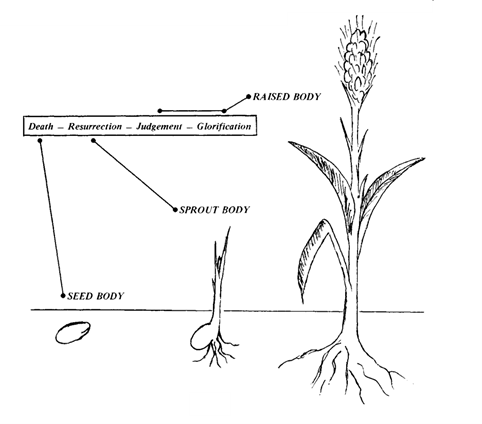
"it is raised in incorruption" - The word 'raised' is EGERTHESONTAI and signifies to raise up, or again, to rebuild, to cause to exist. (See notes on this word in previous boxed section). Dr. Thomas says that the word "includes the whole process of rebuilding from the awakening to the quickening". The individual having been awakened from sleep in the dust of the earth assumes his former identity, mentally, morally, and physically and stands before the judgement seat of Christ in a state of 'corruption', 'weakness', 'dishonour', the possessor of a natural, living body. If accepted by Christ as worthy, saints will undergo a change "in a moment, in the twinkling of an eye" into a state of incorruptibility or immortality. He is then said to be "raised in incorruption". This is the third and final stage of the process after the pattern of raising grain.
The three stages are:—
1. The seed body — Burial of Dead Body
2. The sprout body — Resurrection
3. The raised body — Immortalised
These stages are illustrated in the diagram.
In verses 42 to 44 the apostle presents the contrasts between the resurrected body and the glorified body.
Note the pattern of these contrasts: —
| "Sown" | "Raised" |
| 'It springs forth' | 'It is caused to exist' |
| IN | IN |
| Corruption | Incorruption |
| Dishonour | Glory |
| Weakness | Power |
| A natural body | A spiritual body |
V.43 - "dishonour" - ΑΤΙΜΙΑ - denotes dishonour, ignominy, disgrace. "glory" - DOXA - denotes renown, splendour, brilliance, glory.
"weakness" - ASTHENEIA - denotes want of strength, infirmity, weakness, feebleness.
"power" - DUNAMIS - signifies natural capability, inherent power, capability of anything.
V.44 - "a natural body" - PSUCHIKON SOMA - a living body. This then is contrasted with a spiritual body or a body empowered by Spirit.
V.45 — In this verse the apostle demonstrates the difference between natural life and spiritual life in the resurrected state by contrasting the first Adam with the last Adam.
"The first man Adam" - Adam was the only man (excepting Eve) not to have come into existence by the process of conception in the womb and birth. He was formed into a mature being by the Elohim out of the dust of the ground after their own image and likeness, Gen. 1:26. His experience conforms exactly to that of the resurrected being who likewise will be formed out of the dust into the same image and likeness as his former self.
"was made a living soul" - Roth, and Diag. - "became a living soul". The quality of his nature was natural, earthy, capable of corruption. This is a direct quotation from Gen.2:7.
"the last Adam was made a quickening spirit" - Diag. - "the last Adam a life-giving spirit". Christ 'became' a quickening spirit by a process of 'raising' as will his brethren. See Rom.14:9.
The word 'quickening' ZOOPOIEO occurred in verse 36 and signifies to make alive, give life. Christ has been raised incorruptible' and exalted by the Father to become Judge and bestower of eternal life upon all who are worthy - John 5:21-29.
THE CONDITION OR NATURE OF THE RESURRECTED BODY
In "Anastasis" Dr. Thomas states on a number of occasions that the resurrected body will be in condition and nature like the body of Adam before he transgressed and was made subject to death. The following quotations will suffice to reveal the Doctor's mind on this point in 1866.
"This is our present life, intermitted at death, and restored when we awake from our sleep in the dust of sheol. We are then as Adam was when he came from the Creator's hand. The life is organic and terminable; and liable to disturbance from any cause operating judicially."
"so that far as body is concerned in the matter, the one character on record in the Lamb's Book of Life, when glorified, will have been related to three bodies, more or less intimately connected — the first, the body of sin; the second, a body like Adam's before he sinned: the third..."
"The crowd before him in this stage of resurrection, which is simply ANASTASIS, or standing up, are in corruption, dishonour, weakness, and naturality; for those physical qualities are constituents of all bodies begotten or conceived in dust — "Dust of the earth, earthy"; yet 'very good' bodies, in the sense that the first Adam's was 'very good' before he sinned."
It would appear that Dr. Thomas adopted this view on the basis of the context of Paul's quotation of Gen.2:7 in 1 Cor.15:45 but as pointed out in previous notes, it seems obvious that the apostle is simply contrasting the natural with the spiritual, the earthy with the heavenly and the terrestrial with the celestial. It is evidently not his intention that we should assume that the resurrected body will be in the 'very good' state but rather in a natural and earthy condition in contrast to the belief of some that the body would emerge immortal and incorruptible.
In relation to destiny
It has been suggested that Dr. Thomas' view is correct if seen from the point of view of Adam's relation to destiny. Adam, before he sinned, was not subject to death and his destiny depended upon the intervention of the divine edict or sentence acting upon him judicially to grant him immortality or consign him into mortality or subjection to death. This is said to be the state in which the dead having been raised will stand before Christ. They will be raised in a 'very good' state having paid their debt to the Law of sin and death and experienced the consequences of mortality.
There seems to be little evidence for this view however. Of the many cases of resurrection in the scriptures there are some where dissolution of the body had occurred (e.g. Matt.27:52-53) and some where corruption had set in (e.g. John 11:39). In all the cases of resurrection it is evident that every one, except the Lord himself, died again in due time and experienced corruption. It is clear therefore that the resurrected body remains subject to death. This conforms to the pattern observed in the typical resurrection of Daniel and of the Lord himself who commanded Mary not to touch him till he had 'ascended' to his Father. (John 20:17)
Dr. Thomas in Eureka Volume Three
As time went on, subsequent to the publication of Anastasis it appears that the Doctor modified his understanding on the subject of the condition of the resurrected body. A few quotations from Eureka volume three adequately demonstrate this point.
"This would not have been affirmed of him (Christ) while dead. But the dead body was made to live again. It was thus restored to its former life; brought back to what is was before; the risen Jesus waited to be changed, or transformed, into what he was not on emerging from the tomb. The true believers who hope not to die, knowing that flesh and blood cannot inherit the kingdom, are also waiting to be changed or transformed into what they are not. The position of Jesus and this remnant is identical". Page 383
"This coming forth of the future constituents of the perfect man from the graves, restores them to an equality with the few among the living, who may attain perfection with them. In this co-equality they are intellectually, morally, and materially alike". Page 586
"But, passing through the grave cleanses no one. They who emerge thence, 'Come forth' with the same nature they carried into it; and therefore their coming forth is resurrection. If the same kind of body did not come forth that was buried, it would not be resurrection, but only surrection, as in the case of the first man He (Jesus) rose again the same Jesus that was buried, only that instead of being dead, he was alive again. He was buried under the curse of the Law, which 'made him a curse for' our benefit (Gal.3:13): He came forth while that same Law was in force and operation, his coming forth upon the arena of his execution did not relieve him from the curse of that Law, which sentenced him to continuous and everlasting death; so that, if they could have recaptured him, the Mosaic authorities would doubtless have returned him into death". Page 587
"I have been rather particular in the exposition of the things connected with the body of Jesus, which being made subjectively to know, 'the way of lives' became the 'way' (John 14:6), illustrative of the manner in which all his brethren will experimentally pass from the humiliation of death to the exaltation of eternal life and glory. They, as he, come forth from the unclean house of death earthy, and, therefore unclean bodies". Page 589
"All that comes out of the ground is cursed, and unclean; so that even the body of Jesus, and the bodies of the approved saints in resurrection, require to be justified, rectified, purged or perfected, by all-absorbing spirit: which makes every atom of their substance instinct with incorruption, and life; in other words, transforms it into spirit". Page 705
If the context from which these quotations have been made is examined, it will be seen that Dr. Thomas is emphasising that in nature and condition the resurrected body will be identical to those who are 'alive and remain' unto the return of Christ.
THE THREE STAGES OF RESURRECTION ILLUSTRATED IN DANIEL'S TYPICAL DEATH AND RESURRECTION - DANIEL 10
In the third year of Cyrus, the year of Daniel's death, a vision was given to the prophet of 'a Certain Man' or 'Man of the One' who represented the Multitudinous Christ, the perfected and glorified ecclesia of which Daniel himself was to be a member. Having beheld the vision Daniel describes the experience which then overtook him — a typical enactment of his own death, resurrection, judgement and glorification as an example of the process he and others would have to pass through to become part of the 'Man of the One'.
Daniel's Typical Death — Daniel 10:8-9
V.8 — "There remained no strength in me, for my vigour turned in me into corruption and I retained no strength" - The loss of strength and bodily vigour is tantamount to the passing of life from the body.
V.9 - "then was I in a deep sleep on my face, and my face toward the ground" - Daniel was prostrate upon the ground in a deep sleep. This is a graphic enactment of death.
The First Stage of Daniel's Resurrection — Daniel 10:10
V.10 - "And, behold, an hand touched me, which set me upon my knees and upon the palms of my hands" - The application of power brought about a renewal of existence but its effect was partial, not complete. He had life but was not vigorous. This is typical of the reformation of the dead and their emergence from the grave.
The Second Stage of Daniel's Resurrection — Daniel 10:11-17
V.11 - "and stand upright" - He was now the subject of ANASTASIS, the standing up of dead ones.
"I stood trembling" — Though standing Daniel remained extremely feeble and evidently in a state of fear.
V.15 - "I set my face toward the ground and I became dumb" – Daniel's weakness is revealed here. He was conscious that his nature was still earth-tending and he was speechless, rendering him incapable of giving an account to his judge.
V.16 - "one like the similitude of the sons of men touched my lips: then I opened my mouth, and spake" - This enabled Daniel to give an account of himself at the Judgement Seat of Christ.
The Third Stage of Daniel's Resurrection - Daniel 10:18-19
V.18 - ''there came again and touched me one like the appearance of a man, and he strengthened me" - This signified Daniel's approval and bestowed his reward for faithfulness. It is equivalent to being changed 'in a moment, in the twinkling of an eye" into a state of incorruptibility.
V.19 - "peace be unto thee, be strong, yea, be strong" - Typically Daniel now stood forth immortal in the tranquility of unfading strength.