
The glory and joy that will be the lot of those who are "raised incorruptible" is almost unspeakable, for "eye hath not seen, nor ear heard, neither have entered into the heart of man. the things which God hath prepared for them that love him". The nearest thing to it is perhaps found in the vision of Bro. Roberts as he gives a cameo of life in the Land of Promise during the Kingdom Age in his work "The Final Consolation". There are some interesting points of fact that can be considered however, which help to add to the reality of our vision.
INSTANTANEOUS TRANSFORMATION - 1 Cor.15:51-54
The apostle Paul exults in the glorious prospect of "bearing the image of the heavenly" in the day that the Lord Jesus Christ "shall change our body of humiliation, that it may be fashioned like unto his glorious body" (Phil. 3:21).
The change into immortality will be effected instantaneously by the application of spirit power and all the worthy saints will experience this change at the same time. This was prefigured by the erection of the Tabernacle in the wilderness in one day, after a long period of preparation of the materials - Ex.40:2. The Tabernacle was typical of the whole process of redemption and the glory at the end of that process. Within the vail stood the Ark with its mercy seat and cherubim representing Christ and his glorified ecclesia. By erecting this structure "in a moment" before all Israel Moses foreshadowed the instantaneous formation of the "tabernacle of Deity".
THE IMMORTAL CONSTITUTION
In 1 Cor. 15:50 the apostle Paul states quite categorically that "flesh and blood cannot inherit the kingdom of God". The immortal body must therefore be of a different constitution than the mortal. Jesus the forerunner has left us with a clear idea of its constitution. When he appeared to his terrified apostles in the days following his resurrection he eased their troubled minds by advising them to handle him to prove his reality, saying, "for a spirit hath not flesh and bones, as ye see me have", Luke 24:39. Flesh and bones then, make up the physical constitution of the immortal body. Blood is absent, for it is the life of all mortal flesh but the spirit empowers the incorruptible being and it is "the spirit that quickeneth". The presence of spirit excludes corruption in any form in nature or tendency and thus sin, disease, sickness, sorrow and physical decline are also completely absent — Rev.21:3-4.
RETENTION OF IDENTITY
Though the immortal being will have been perfected in nature and character he will retain his original identity. Those who knew him during his mortal probation will be able to recognise him by his appearance. This is manifest from the example of Christ who being immortalised presented himself to his disciples and was recognised by them - John 20:19-29.
This raises the question as to whether saints will carry physical abnormality into the Kingdom. Every principle of scripture is against this. The priesthood of Israel were to be physically perfect - abnormality disqualified them from priestly duty - Lev.21:17-23. It is certain that the Millennial priesthood will not take with them into the Kingdom the marks of the weakness and corruption of the flesh.
Hence, while physical identity will not be lost, bodily infirmity or abnormality will be entirely absent.
MALE OR FEMALE?
While male and female immortals will be readily identifiable, the change into spirit nature will involve the fusion of masculine and feminine qualities into the one being.
As for parts of the human body so essential to the natural functions of human life and continuance of the race; these will not be required in the immortal state. For immortal saints, marriage as presently experienced, will have become an unnecessary and undesired institution - they having passed beyond that into a far higher state of marriage with their heavenly bridegroom, Luke 20:36, Rev.19:7. Instantaneous transformation will also mean the change or loss of those bodily organs and functions incidental to their present mortal state which will then have fallen into redundancy - 1 Cor.6:13, Rev.7:16.
TRUST
Still trust in God, then may these days of evil
Purge out the dross, and leave some gold revealed,
As tropic spices, bruised and crushed and broken
Yield out a fragrance oft concealed.
If thou wouldst fit a stone in Yahweh's temple,
Thou too must shaped and tried and polished be.
The process may seem hard and unrelenting,
Yet what abiding good 'twill work for thee!
THE MARRIAGE OF THE LAMB
JOYOUS ACTIVITY AT SINAI
The departure of the rejected and unworthy from the judgement seat will be followed by a scene of unmixed joy and consolation as the worthy and glorified saints are united to their Lord and husband.
The bridegroom will take unto himself the multitudinous "chaste virgin" (2 Cor.11:2) as his bride and institute a period of joyous fraternisation among the whole company of the Redeemed. The time of which John spoke in Rev. 19:7 will have then become a reality:
"The marriage of the Lamb is come, and his wife hath made herself ready”.
John's words are actually in the past tense in the original Greek, as the marriage takes place before the events narrated in the earlier verses. The marriage of the Lamb will be at Sinai while the marriage feast or supper will be celebrated at Jerusalem some time subsequently.
It is evident that some time will be spent in the precincts of Sinai in joyous fraternisation. The law of the newly weds in Deut.24:5 exempting a man recently married from military service for one year prefigured a similar period set aside for the participants in the greatest marriage of all.
Scripture abounds with references to the exultant joy of the Redeemed as they give vent to their gratitude to God and His son. The praise and thanksgiving of all saints will fill this period of time with a rejoicing and happiness never before witnessed upon earth — Rev.5:8-12, 7:11-12, 19:4-7, Ps.149, Isa.26:19, 25:8-9.
The unity that Christ will share with his bride will see the fulfilment of such prophecies as Isa.26:20-21, Song of Sol.2:10-13.
HIS WIFE HATH MADE HERSELF READY
In Rev. 19:7-9 from whence this heading is taken there is a distinct emphasis upon the preparation of the bride. The glory and blessedness received by those who are united in marriage to Christ will not have come without much preparation on their part. The preparation and maintenance of their wedding garment will have cost them a lifetime of sacrifice, trial and tribulation through complete identity mentally and morally with their bridegroom.
The ideas of which the apostle speaks in Eph.5:22-32 will have become a reality in their experience. They will then be mentally, morally, and physically one with their husband and Lord, "a glorious ecclesia, not having spot, or wrinkle or any such thing".
Christ's requirements in his bride provide the only basis for a successful, harmonious, and fruitful marriage in our days of probation. They are:-
1. Chasteness, or sanctification - 2 Cor.11:1-2, Eph.5:26-27
2. Mental, moral, and physical compatibility.
Concerning the former; the basis of successful marriage is separation from "all that is in the world" and a sanctification to God, in both partners. Concerning the latter; mental and moral parity and reciprocation are essential prerequisites for a successful and happy marriage.
Whether we speak of marriage now or the marriage of the Lamb to his bride, present and ultimate success can only be achieved in one way. The beauty of Christ's bride is derived from the application of the Word and its transforming power (Eph.5:27) and this is the key to the attainment
of the ideals of marriage. Those who constitute the Lamb's wife will not be ignorant of this principle.
PREPARATIONS FOR WAR
Whilst the nations are in the final stages of being gathered to Jerusalem for the battle of the great day of God Almighty, Christ will be preparing his immortalised brethren for the warfare that lies before them.
To fully prepare the saints for the many and varied tasks before them will take some considerable time. It is certain that Christ will not leave Sinai until like Israel of old, the Israel of God, Yahweh Sabaoth or the Rainbowed Angel has been formed into an organised and well trained army. Perhaps like Israel, Yahweh's cherubim will march forth from Sinai in four divisions at the steps of the unveiled ark of the covenant, the Lord Jesus Christ in glory - Num.10, Ezek.1, Rev.19:11-16.
THE MARCH OF THE RAINBOWED ANGEL
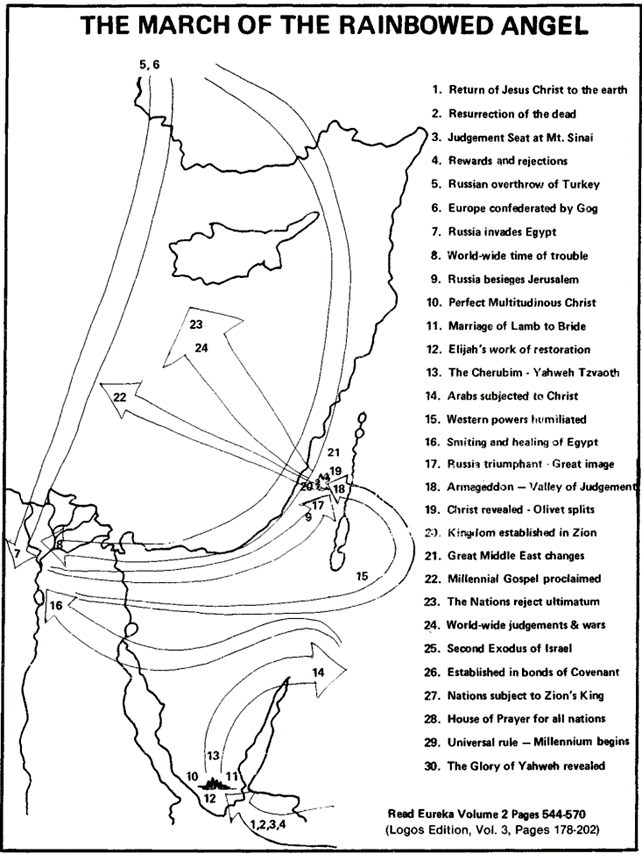
The mighty angel of Rev. 10:1 standing astride the earth clothed with a cloud and shrouded by a rainbow presents a graphic symbolic picture of Christ and his glorified saints standing victorious over all countries surrounding the Mediterranean and over Catholic Europe. John sees Christ near the end of his work of subduing the nations, hence much has been accomplished since the mighty angel left Sinai.
The following illustration depicts the march of the rainbowed angel and the order of events leading up to the time of his conquest over Europe and all Mediterranean powers, and beyond. These notes will proceed to deal with those events as they will occur chronologically. For a full treatment of this subject read Eureka vol.2, chap.10, Pages 533-585.
THE CONQUESTS OF THE RAINBOWED ANGEL - Rev.10
John observes a rainbowed angel with an open book in his hand standing astride earth and sea as a conquerer. He listens to the seven thunders uttering their voices and though forbidden to record them is invited to eat the little book as an indication of his involvement in the events it recorded.
Finally, he receives the assurance that he will yet preach the Gospel to all peoples of the world in the future age.
V.1 - "And I saw another mighty angel" - This angel is distinct from the seven angel-trumpeters. The description identifies him with the "one like unto the Son of Man", Rev.1; the Multitudinous Christ.
"clothed with a cloud" - The symbol of a multitude - Heb.l2:l, Ezek. 38:9. The whiteness of the cloud suggests righteousness - Rev. 19:8. The cloud represents the saints in glory.
"and a rainbow was upon his head" - Formed by the rays of light emanating from the angel's face passing through the cloud! The light is refracted by tiny water droplets which act as a prism separating pure white light into its seven colours. The rainbow is the token of Yahweh's covenant of peace with flesh following destructive judgements, Gen.9:11-16. Here it represents the divine covenant of peace, to be brought about by the work and influence of the saints as with John they go forth to shower Yahweh's doctrine (Deut.32:2) upon all peoples under the direction and guidance of the Sun of Righteousness (Mal.4:2), thus establishing harmony between God and men - cp. v . 11.
"his face was as it were the sun" - Christ is the sun of righteousness (Mal.4:2) and together with his saints will shine forth in the Kingdom Age (Matt. 13:43) reflecting the divine glory to all corners of the earth.
"his feet as pillars of fire" - These are the feet of the Multitudinous Christ (Zech.l4:4). Fire is a symbol of judgement as well as of the presence of Yahweh. These feet go forth bearing the name of Yahweh (Isa. 30:27) and carrying His judgements to the nations of the earth until they stand entrenched in the 'sea' and upon the 'earth', triumphant.
V.2 - "And he had in his hand a little book open" - The Greek word BIBLARIDION describes a little scroll or book. It is small in comparison with the seven-sealed scroll because its contents cover but a short period of time, perhaps 40 years. Being in the hand of the angel it indicates that it contained the work he was to perform. No mention is made of its contents, but it is certain they pertained to the judgement of the nations.
Ezekiel had an identical experience to John (Ezek.2:9 — 3:14) and the scroll he consumed contained "lamentations, mourning and woe" against the iniquitous house of Judah. The little scroll consumed by John doubtless likewise contained a proclamation of the divine purpose with the earth and the judgements required to bring that purpose to its fulfilment.
"he set his right foot upon the sea and his left foot upon the earth" - John beholds the angel apparently standing still, which means that dominion has been obtained over the area he bestrides. The sea' is obviously a reference to the Mediterranean. The angel represents Christ and the saints victorious over the powers of the Mediterranean, chief of which is the Gogian confederacy with its headquarters in Constantinople (military) and Rome (ecclesiastical).
The 'earth' is clearly a reference to Catholic Europe (Rev. 13:1,11), and so Christ stands victorious over the image of Nebuchadnezzar in its Gogian and Catholic manifestations. What now remains is to grind the image to powder and fill the earth with God's glory.
V.3 — "a loud voice a lion roareth" - All the world will hear the voice of the Lion of the tribe of Judah — Rev.5:5.
"seven thunders uttered their voices" - "The Jews were accustomed to speak of thunder as the seven voices" (Vincent). The expression is drawn from Psalm 29 where "the voice of Yahweh" is aligned with thunder, v.3, and the phrase is repeated seven times - v.3,4,5,7,8,9.
Thunder is symbolic of judgement and war. Seven thunders suggests seven campaigns by Christ to totally subjugate the nations to his rule. The outpouring of divine judgement after Armageddon will finally crush all resistance to Christ's rule after the pattern of David's campaigns - 2 Sam.8 to 10.
V.4 — "seal up those things which the seven thunders uttered" – So terrible were "the judgements written" (Ps.149:9) that John was not permitted to record them.
V.5 - "lifted up his hand to heaven" - Diag. - "raised his right hand towards heaven". The right hand is the symbol of strength, direction, and authority. By raising it to heaven the angel indicated the surety and irrevocability of the fulfilment of these things, Dan. 12:7.
V.6 — "that there should be time no longer" - When the mighty angel goes forth, the time periods outlined by the angel to Daniel will be about to find their completion — Dan. 12:7. Once the seventh angel sounded there would be no delay in executing the final vengeance.
V.7 - "when he shall begin to sound" - The Greek MELLO denotes, "when he is about to sound". However, the statement, "in (EN – within) the days of the voice", indicates that the seventh trumpet which commenced in 1793 with the end of the French Revolution, will continue to the fulfilment of the divine purpose. The final judgements will occur during the period of the seventh trumpet, but not necessarily at its beginning.
"the mystery of God should be finished" - Diag. - "the secret of God should be completed". The secret of God is no mystery to His servants - Rom.16:25-26.
"as he hath declared to his servants the prophets" - Bro. Thomas translates, "announced its glad tidings". The Greek word EUANQELISE is used elsewhere of proclaiming the good news of salvation. The Gospel was preached to and through the prophets.
V.8 - "Go and take the little book" - John's experience is almost identical to Ezekiel's - Ezek.2:9-10, 3:1-3, 14.
V.9 - "Take it and eat it" - The eating of the little scroll is a graphic symbolic portrayal of John's own personal involvement in the outworking of the divine purpose and judgements recorded therein. Moreover, John represents all his brethren who will likewise participate with him as part of the Rainbowed Angel.
"and it shall make thy belly bitter" - Comparing John's experience with Ezekiel's, bitterness implies fierce anger, judgement and destruction - Ezek.3:14. The scroll proclaimed judgements against an unrepentant world, and in eating it John demonstrated his involvement.
"but it shall be in thy mouth sweet as honey" - Honey is both soothing and strengthening, and therefore is an apt illustration of the power and influence of the Truth, Ps.19:10-11, Prov.24:13-14. To such as John the Word of God is sweet, even if it speaks of judgements so awful that they are unutterable.
V.10 - "and as soon as I had eaten it my belly was bitter" – John's experience was exactly as 'the voice' had predicted. The divine edict was sweet upon its reception and productive of bitter indignation against a godless world upon its absorption.
V.11 - 'Thou must prophesy again" - To prophesy is to teach and educate in the things of the Truth and to declare the will and purpose of God — 1 Cor. 14:3. Following the judgements of Armageddon the saints will be sent into all parts of the world to teach and educate men in the things of God and to declare to them the divine will and purpose. The cloud (v. 1) will pour down rain (God's doctrine - Deut.32:2) upon the humbled nations (Ps.72:6) until the knowledge of Yahweh's glory covers the earth (Hab.2:14).
"before many peoples, and nations, and tongues and kings" - The redeemed will have been taken out of such - Rev.5:9-10. John who represents them will again preach the Gospel of Millennial salvation and so will all the redeemed. Evidently many will be sent back to the countries of their origin and probation to teach the people that remain the things of the Truth. Once ignored, despised and persecuted, they will now receive a ready and willing response to the things they teach. What a glorious prospect this is for the faithful like John.
SYNCHRONISATION OF EVENTS OCCURING AT THIS TIME
While Christ is at Sinai preparing his saints to go forth with him, many things are happening in the world which gather all nations to "the battle of that great day of God Almighty" at Armageddon. Although many things will occur simultaneously, the following is an attempt to provide an order of events from Russia's advance into Turkey to Christ's appearance at Jerusalem.
1. Russia having formed an alliance with the Catholic Church and the nations of Europe will advance on Turkey.
2. Once established in Constantinople (Nebuchadnezzar's Image now nearing completion with but Israel and Egypt to be incorporated) the Russian forces will rapidly advance down the coastal plain of Israel, by-passing Jerusalem, and invade Egypt.
3. Elijah is sent forth to gather scattered Israel, while Christ and the saints move from Sinai, northwards, and subdue the Arab powers of the region.
4. The Tarshish powers enter the conflict and consolidate their power in and around Jerusalem.
5. After subduing and occupying Egypt the Russian forces receive tidings out of the east and the north which trouble them.
6. Leaving an occupation force, the Gogian confederacy advance upon Jerusalem and engage the forces of the west around Jerusalem.
7. Christ and the saints enter Egypt, subdue Gog's occupying army and relieve Egyptian distress. They commence the work of converting Egypt.
8. Gog is victorious over all opposition in the land of Israel and sets his seat of power in Jerusalem.
9. Christ and the saints having left Egypt travel east to Mt. Paran, Mt. Seir and the Dead Sea conquering any resistance encountered, and enter the land due east of Jerusalem, arriving at the Mount of Olives as Gog is going about the task of taking the remnant of the Jewish nation into captivity.
10. Christ and the saints use divine power to overthrow Gog's forces and an earthquake makes dramatic changes to the topography of the land.