
THE CRUCIFIXION AND RESURRECTION OF JESUS CHRIST
Reading: Matthew 21-28
All the gospel records give a detailed account of the last week of the life of Jesus, leading up to his crucifixion. Each writer concentrates on certain incidents, picking up different aspects of the events of that last week. John in his gospel from chapters 12–17 records much of the discussion that took place on the night before Jesus’ crucifixion.
We will select just some of the incidents to comment upon. It is recommended that time be spent carefully reading through each of the gospel accounts of these remarkable incidents (Matthew 21-28; Mark 11-16; Luke 19-24; John 12-21).
LAST DAYS OF THE LORD’S LIFE
| EVENT | QUOTE | |
| Day 1 | Mary anoints Jesus’ feet Jesus enters Jerusalem |
Matthew 26:6-13 Matthew 21:1-11 |
| Day 2 | Curses the Fig tree Cleanses the Temple |
Matthew 21:18-19 Matthew 21:12-14 |
| Day 3 | Jesus argues in the Temple Gives Olivet prophecy on Mt of Olives |
Matthew 22:15-46 Matthew 24:1-31 |
| Day 4 | Parables and warnings for disciples The Last Supper Agony in Gethsemane and betrayal |
Matthew 24:32- 25:46 Matthew 26:17-30 Matthew 26:36-56 |
| Day 5 | Trials of Jesus Crucifixion and burial Women prepare spices |
John 18:14-19:16 Matthew 27:31-27:61 Luke 23:56 |
| Day 6 | Watch is set | Matthew 27:62-66 |
| Day 7 | Resurrection |
Mt of Olives and Jerusalem
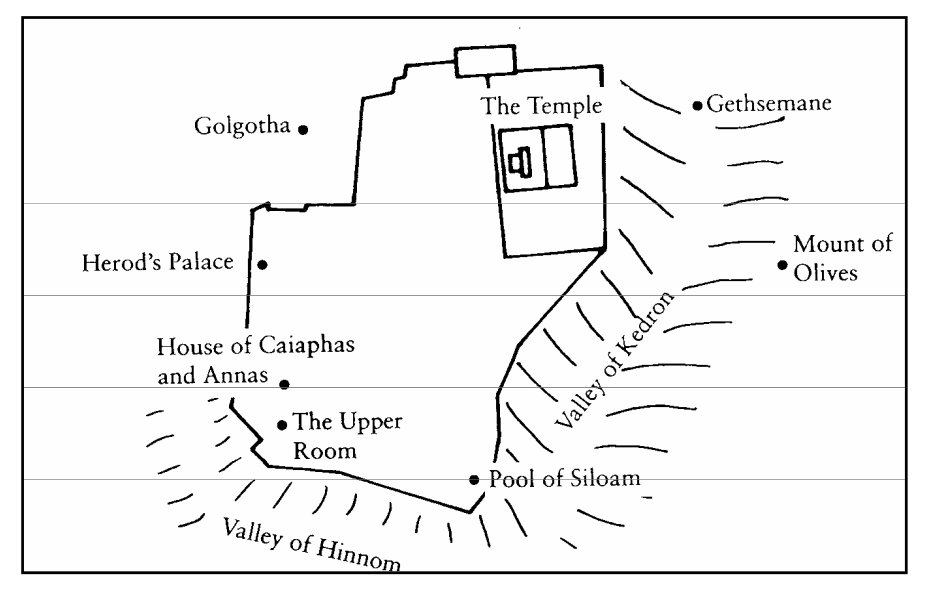
Jesus Journeys from Jericho to Jerusalem
Six days before the Passover—the day of his crucifixion—Jesus journeyed up from Jericho to Bethany which was on the Mount of Olives on the east side of Jerusalem, and spent the evening at the home of his friends, Mary, Martha and Lazarus (John 12:1–11). Their home became his base for the next few days as he walked about 2 kilometres from Bethany to Jerusalem and returned there in the evenings (Matthew 21:17). Several months earlier Lazarus had died and Jesus had raised him to life again (John 11).
Jesus Enters Jerusalem Riding upon a Colt (Matthew 21:1-9)
The well-known event of Jesus entering Jerusalem upon a colt, the foal of an ass, took place the next day. This incident had been foretold in Zechariah 9:9: “Rejoice greatly, O daughter of Zion; shout, O daughter of Jerusalem: behold, thy King cometh unto thee: he is just, and having salvation; lowly, and riding upon an ass, and upon a colt the foal of an ass.”
As Jesus entered the city the crowds who were making their way there for Passover cast their garments and branches of trees before him, crying out, “Hosanna [‘save now’]; Blessed is he that cometh in the name of the Lord: Blessed be the kingdom of our father David, that cometh in the name of the Lord: Hosanna in the highest” (Mark 11:9-10).
Luke adds that they said: “Blessed be the King that cometh in the name of the Lord” (Luke 19:38).
The great crowd who accompanied Jesus as he entered the city praised God, using the very words of Psalm 118:25–26, and this angered the chief priests, scribes and Pharisees.
The people however, saw Jesus as the one who
• came in God’s name
• would be King
• would reign over the Kingdom of David.
Although their timing was wrong, they understood that God had foretold that the son of David would re-establish the Kingdom of God on earth at Jerusalem.
Jesus Cleanses the Temple
On one of those days when Jesus entered Jerusalem he went into the Temple and found there traders buying and selling animals for sacrifice, and also the money changers. As a great multitude had gathered for the Passover it was a lucrative time for the traders of animals and birds for sacrificial offerings, but Jesus recognised immediately that all this activity ignored the real reason for converging on Jerusalem, namely, to worship God in remembering the Passover deliverance. In one of his rare outbursts of anger, Jesus
“began to cast out them that sold and bought in the Temple, and overthrew the tables of the moneychangers, and the seats of them that sold doves”, saying, “Is it not written, My house shall be called of all nations the house of prayer? But ye have made it a den of thieves” (Mark 11:15-17; cp Isaiah 56:7). The quotation from Isaiah anticipates the time in the age to come, when a great house of prayer and worship will be built in Jerusalem for all people (Isaiah 2:2-4; Zechariah 14:16–19).
By What Authority Doest Thou These Things?
The chief priests and elders of the people were incensed by Jesus’ actions. Through their traditions they had formalised religion and turned it into a profitable business which supported their lifestyle. Peter later warned of where this would lead: “There shall be false teachers among you...and many shall follow their pernicious ways; by reason of whom the way of truth shall be evil spoken of. And through covetousness shall they with feigned words make merchandise [Gr emporium—‘a place of trade’] of you” (2 Peter 2:1-3). The behaviour of the Pharisees has been repeated even amongst Christians down the ages, just as Peter foretold, and many religious leaders have been notorious for the way they have exploited the people and denied them access to the truth (cp Jesus’ words in Matthew 23:13).
This incident increased the hatred of the religious leaders against Jesus. They set their hearts to plot how to kill him, but their efforts failed until finally they found in Judas Iscariot a weakness for money, for he was a thief (John 12:6). They offered him thirty pieces of silver to betray Jesus to them, which he agreed to do. The details of these final days and the events that took place are found in Matthew 21–25.
The Olivet Prophecy (Luke 21; Matthew 24)
On leaving the Temple for the last time the disciples remarked on the beauty of the buildings. Jesus told them that the time was coming when not one stone of the Temple would be left upon another, for it would be completely destroyed. Astonished, they asked him when this would happen and how it would be accomplished.
Jesus then detailed the events that would lead up to the destruction of the city in AD 70 by the Roman army, followed by the scattering of the Jews among all nations (Luke 21:20-24). However he went on to tell his disciples that he would certainly come to establish the Kingdom, but though he had told them many times that he must first suffer and die, they could not comprehend what he meant. return to the earth, He did not want them to despair, but to be assured that he would come again. So he gave them clear signs that would herald his return to set up the Kingdom of God (Luke 21:25-36).
Among the signs listed he foretold of the moral collapse of society, so bad that it would parallel the wickedness of the days of Noah (Matthew 24:36–39). He also spoke of international tension that would bring distress and perplexity, times which would fill men with a sense of hopelessness, for there would seem to be no way out (Luke 21:25). He concluded his warning with these words:
“Watch ye therefore, and pray always, that ye may be accounted worthy to escape all these things that shall come to pass, and to stand before the Son of man” (Luke 21:36). All who wish to be found prepared and waiting for the return of the Lord Jesus Christ should read and consider these prophecies.
The Last Supper in the Upper Room (Matthew 26:17-30)
On the night before he was crucified, Jesus gathered with his disciples in an upper room in Jerusalem. There were many important things that he said and did on this occasion but one event is of particular importance. This was his institution of the way by which his disciples were from that time forward to remember him and what he had done for them. He knew it would be vital for them to regularly call to remembrance his loving sacrifice and so he gave them as a memorial the emblems of bread and wine.
• The Bread: Jesus “took bread, and gave thanks, and brake it, and gave unto them, saying, This is my body which is given for you: this do in remembrance of me” (Luke 22:19). The bread was to symbolise his body, a body which he always surrendered to the will of his Father (Hebrews 10:5-10; Philippians 2:8). Shortly, in the garden of Gethsemane, after an enormous mental and emotional struggle, he would yield also to that final agony of death upon the cross. “Not my will, but thine, be done”, was as always his response. His body was the antitype of the body of the Passover lamb which was “without blemish” (1 Peter 1:18-19; 1 Corinthians 5:7).
• The Wine: As Jesus distributed the wine he said: “This is my blood of the new testament [or, covenant], which is shed for many for the remission of sins” (Matthew 26:27-28). The wine represented his blood, his life blood. His blood was the ‘antitype’ (the fulfilment of the ‘type’) of the blood of the Passover lamb, which was shed for the redemption of Israel. So “the precious blood of Christ” has been shed once for the redemption of all mankind (1 Peter 1:18-19). Through a life of perfect obedience, culminating in his crucifixion in obedience to the will of God, he has made possible the forgiveness of sins for all who come to God through him.
The simple act of partaking of these memorials is observed by all those who wish to obey their Lord’s commandments (cp 1 Corinthians 11:23-29). This unites them in fellowship with him, as they strive to appreciate his wonderful example of life and the great price that has been paid for man’s salvation (1 Corinthians 10:16–17). By partaking of the bread and wine a believer mentally assimilates into his/her life the life of the Lord Jesus Christ, so that he is seen, as it were, living in him (John 6:51-57; Galatians 2:20).
The Significance of the Death of Jesus Christ
We recall that when John the Baptist saw Jesus near Jordan he declared: “Behold, the Lamb of God, which taketh away [‘beareth away’] the sin of the world” (John 1:29). John was alluding to the words of the prophet Isaiah, who dramatically foretold the saving work of Jesus Christ in Isaiah 53. In that remarkable prophecy, mankind are spoken of as sheep who have gone astray, having “turned every one to his own way” (verse 6). How descriptive this language is—for all have turned from God’s way and sinned (Romans 3:19, 23).
Yet one man stands out in contrast, one who was “despised and rejected of men; a man of sorrows and acquainted with grief” (verse 3). This man is described as “a lamb” upon whom is laid “the iniquity of us all” (verse 6-7). Peter quotes the same passage when he acknowledges the great debt of gratitude that we owe to Jesus Christ, the Son of God (1 Peter 2:22-25).
In the days of the apostles, a traveller was puzzling over these very words and wondering, “Of whom speaketh the prophet this? Of himself or of some other man?” (Acts 8:34). Philip, sent by God, enlightened him, and “began at the same scripture and preached unto him Jesus”. Isaiah is plainly referring to the Lord Jesus Christ and his work of redeeming mankind from sin and death.
Isaiah speaks of this one who was to “bare the sin of many” (verse 12), making “his soul [life] an offering for sin” (verse 10), and again pouring out “his soul [life] unto death” (verse 12). So Jesus Christ, through the yielding of his life in perfect obedience to God, even to his sacrificial death upon the cross, provided the way of forgiveness of sins for all mankind, reconciling man to God.
How was this so?
• Jesus, who shared the same mortal and sin-prone nature as all mankind overcame the temptation to sin by the positive action of always doing the will of God. The Psalmist foretold this, saying: “I delight to do thy will, O my God: yea, thy law is within my heart” (Psalm 40:7-8; Hebrews 10:7). Though he was tempted in all points like us, he never sinned (Hebrews 4:15).
• It was through his death that he publicly condemned and destroyed once and for all that sinful tendency that all mankind have inherited from Adam: “Forasmuch then as the children are partakers of flesh and blood, he also himself likewise took part of the same; that through death he might destroy him that had the power of death, that is, the devil” (Hebrews 2:14).
• In his death he “crucified the flesh with the affections and lusts” (Galatians 5:24). Though he was crucified, it was he who had the victory! Sin never triumphed over him, for he always did the will of God. “Not my will, but thine, be done”, was his wonderful response even in his greatest hour of trial (Luke 22:42).
• Paul describes what was achieved in the death of Christ, when he made “his soul an offering for sin” and “poured out his soul unto death” (Isaiah 53:10-12) in these words: “For what the law could not do, in that it was weak through the flesh, God sending his own Son in the likeness of sinful flesh, and for sin, condemned sin in the flesh” (Romans 8:3). He alone could save us, because he is like us, yet not a sinner.
• Christ shared that same mortality common to all Adam’s descendants. However, though he was put to death by wicked men, it was not right that he should remain dead. “The wages of sin is death” (Romans 6:23), and here was one who had never sinned and so had never earned these “wages”. The resurrection of this man was therefore inevitable. “God hath raised him up, having loosed the pains of death: because it was not possible that he should be holden of it” (Acts 2:24; Philippians 2:8-9). God, who is just, gladly raised His beloved Son after only three days in the tomb, as He had foretold (Psalm 16:10; quoted in Acts 2:27). He became therefore “the author of eternal salvation unto all that obey him” (Hebrews 5:9).
Baptism—Identification with Christ’s Crucifixion (Romans 6:3-6)
We can now begin to appreciate more fully the significance of baptism, by which we are reconciled to God. In baptism we identify with what the Lord Jesus Christ achieved in his death, his ultimate victory over the power of sin (Hebrews 2:14). Paul draws the parallel between Jesus’ death and our baptism, stating: “our old man is crucified with him, that the body of sin might be destroyed, that henceforth we should not serve sin” (Romans 6:6). Our “old man” is the person we used to be, before we were reconciled to God. In baptism our “old man” dies. We repudiate “the body of sin”, our former sinful God-dishonouring ways. We acknowledge that God is right in so condemning sin.
But there is, of course, that other dimension to baptism. Just as Christ rose from the dead to die no more, so we rise from the water as a “new man” (or, person) in Christ (Ephesians 4:20–24). Our past sins have been forgiven, and we commence a new way of life following the pattern of our
Lord Jesus Christ (Romans 6:16-18; 1 Peter 2:21–25).
There are some helpful passages of Scripture which reveal these two dimensions—Romans 6; Colossians 3: 1–15; Ephesians 4:17–32.
Consider some of the other lessons Paul draws from identifying in baptism with the crucifixion of Christ:
• Paul saw himself as dead and the life he now lived revealed the life of Christ in him (Galatians 2:20).
• Those who, through baptism, are Christ’s, have crucified the flesh with the affections and lusts (Galatians 5:24).
• Through his identification with the death of Christ the world was “crucified” to him and he to the ways of the world—life in Christ was everything (Galatians 6:14).
Crucifixion was an excruciatingly painful ordeal. Cutting off old habits, turning our back on a former way of life, can certainly be painful and difficult. Yet as we commit our ways to serving God and doing His will, the joy of such service gives strength and encourages us to continue, by God’s grace. It is said of Jesus, that “for the joy set before him he endured the cross, despising the shame, and is set down at the right hand of the throne of God” (Hebrews 12:2). So those who follow his pattern of life can be daily encouraged to view their lives as a preparation for that time when they will be one with him and his Father “in his throne” (Revelation 3:21).
The Resurrection of Jesus (Matthew 28 & Luke 24)
The entire message of the Gospel—the good news—depends on the resurrection. The resurrection of Jesus Christ is recorded in all four Gospels. As the reality of this momentous fact dawned upon the apostles and followers of Jesus, sorrow and despair gave way to exuberant joy. His resurrection became the guarantee that all that God had promised would be performed. In fact the apostle Paul very boldly states: “If Christ be not risen, then is our preaching vain and your faith is also vain” (1 Corinthians 15:14). In this chapter he proves the historical fact that Christ is risen, by naming those who had actually seen him alive after he rose from the dead (1 Corinthians
15:4-8).
The marvel of the resurrection of Christ from the dead is both an undeniable historical fact and the foundation upon which our faith in the living God is soundly based.
Through the resurrection of Christ the way to victory over sin and death has been opened for all who come to God through faith in him.
“For since by man came death, by man came also the resurrection of the dead. For as in Adam all die, even so in Christ shall all be made alive. But every man in his own order: Christ the firstfruits; afterward they that are Christ’s at his coming” (1 Corinthians 15:21-23).
When Christ returns, his first work will be to raise those who have known the gospel, and therefore are responsible. This includes those who in their lifetime believed the gospel and were baptised into Christ. Because they died in hope of the resurrection, though quite dead, they are said to “sleep in Jesus” (1 Thessalonians 4:14). At the judgment (John 5:27-29; 2 Corinthians 5:10) those who will be considered by Jesus Christ, the righteous Judge, to be worthy of life will be given immortality. Paul explains this in 1 Corinthians 15, saying:
“Behold, I shew you a mystery; We shall not all sleep, but we shall all be changed, in a moment, in the twinkling of an eye, at the last trump: for the trumpet shall sound, and the dead shall be raised incorruptible, and we shall be changed. For this corruptible must put on incorruption, and this mortal must put on immortality.” (Verse 51-53).
The resurrection of Jesus Christ is therefore the foundation of “the hope” of the Gospel. This “mortal” death-stricken nature will be changed to “immortality” so that we can share in the everlasting Kingdom with Christ.
Christ’s Work in Heaven Now—High Priest of the House of God
We know that Jesus Christ has gone to heaven (Acts 1:9–11) and that he now sits at the right hand of God awaiting the time when God will send him back (Psalm 110:1; Mark 16:19; Acts 3:19–21). There are many references to him being at the right hand of God now (Acts 2:33-34; Romans 8:34; Colossians 3:1-2; Hebrews 1:3; 10:12; 12:2; 1 Peter 3:22).
His great work in heaven is as “high priest over the house of God” (Hebrews 10:21). This present role of the Lord was also foretold in Psalm 110:4. The work he now performs is of vital importance for all who wish to serve God acceptably. We have seen in previous studies that through baptism our past sins are forgiven. However after baptism, though we try even harder to please God, we all still fail through sin. This is when we appreciate the wonder of our great High Priest in heaven, through whom we can communicate with the Father through prayer and seek forgiveness, help and guidance in life (Hebrews 4:16). He is the “one mediator between God and man” (1 Timothy 2:5).
There are many references that speak of this work of the Lord Jesus Christ and show us how fitted he is to fulfil this role on our behalf. He was “touched with the feeling of our infirmities” and was “in all points tempted like as we are, yet without sin” (Hebrews 4:15-16). He is “a merciful and faithful high priest” who, because he has suffered temptation, “is able to succour them that are tempted” (Hebrews 2:17-18). Moreover, access to God is always available through him, for “he ever liveth to make intercession” to God for those who approach in his name (Hebrews 7:24-25). He is our “advocate with the Father” (1 John 2:1-2).
Those who have become members of “the household of God” through belief and baptism into Christ have this glorious privilege of praying to God through him. However God does take note of the prayers of all those who genuinely desire to know Him and are prepared to learn of His ways. God will not hinder us if we have that desire. As Jesus himself said, “This is life eternal, that they might know thee the only true God, and Jesus Christ whom thou hast sent” (John 17:3). We have the example of Cornelius, who prayed to God (Acts 10:1-2), and God heard his prayer and revealed to him the Truth in Christ Jesus; and when he believed it, he was then baptised (Acts
10:47-48).
Prayer—An Essential Part of the Believer’s Life
Jesus said that “men ought always to pray, and not to faint” (Luke 18:1), indicating the importance of prayer as a source of comfort and strength in the life of his disciples. He himself has given an example in this regard for often we read of him praying to God. He also gave the pattern for prayer in Matthew 6:9–13 and Luke 11:1–4. The Psalms are recorded prayers that can be a source of help to guide us in our own prayers to God.
The apostle Paul wrote:
“Be careful for nothing [lit “do not be anxious about anything”]; but in every thing by prayer and supplication with thanksgiving let your requests be made known unto God. And the peace of God, which passeth all understanding, shall keep your hearts and minds through Christ Jesus” (Philippians 4:6–7).
One of the last things Jesus encouraged his disciples to do was to “watch and pray always” (Luke 21:36).
What a great privilege those who are of the “household of God” have through Jesus Christ—the privilege of access to God through him in prayer, and forgiveness of sins.
Summary Points
1. The last week in Jesus’ ministry covers the period from his arrival at Bethany six days before his death through to his crucifixion (Matthew 21-27).
2. The Olivet prophecy foretold both the coming destruction of Jerusalem in AD 70 by the Romans and the subsequent scattering of the Jews, as well as details of the signs that will herald the return of Jesus Christ back to the earth to set up the Kingdom of God (Luke 21:20–36).
3. From the account of the Last Supper in the upper room (Matthew 26:17–30) we are given details of Jesus’ institution of bread and wine as memorials of his body and his blood, given in obedience to his Father’s will (Matthew 26:26–29). Through his sacrifice he has provided the basis for forgiveness of sins for all who believe and are baptised.
4. Paul reminds believers of the soberness and importance of remembering the Lord Jesus Christ in this way when they gather to worship (1 Corinthians 11:23-29).
5. The crucifixion of Jesus was his last great act of complete and willing obedience to God by which he obtained resurrection to immortality (Philippians 2:8-9; Acts 2:24; Romans 5:17-18,21; 6:9–10).
6. Through baptism into Jesus Christ we identify with the principles associated with his death and resurrection (Romans 6:3-8).
7. The resurrection of Jesus opened the way to immortality for all those who believe and are baptised into him (1 Corinthians 15:21-23; Romans 5:21; 6:9,23)
8. Jesus is now in heaven at the right hand of God (Psalm 110:1), where he officiates as High Priest over “the house of God” (Hebrews 10:21). In this role he mediates for those “in him”, making intercession on their behalf to God (Hebrews 7:24-25). We therefore approach God in prayer through him (Romans 8:34; 1 John 2:1-2).
9. Prayer to God in the name of Jesus Christ is an essential part of a disciple’s life—the great privilege of all who are “in Christ”. (Philippians 4:6-7; Luke 21:36; Matthew 6:9-13).
Lesson 21 - Questions
1. In the Olivet Prophecy what did Jesus tell his disciples they must do to be ready for him on his return to the earth?
2. In the upper room what did Jesus ask his disciples to do regularly to remember him?
3. What does the bread represent?
4. What did Jesus say when he handed the wine to his disciples?
5. List some of the lessons we learn from the death of Jesus Christ.
6. How is baptism an identification with the death of Christ?
7. Why is the resurrection of Jesus Christ the great hope of the Gospel? (see 1 Corinthians 15;21-23)
8. What work is Jesus Christ performing on behalf of believers in heaven now?
9. What is the great privilege that members of “the house of God” have now through Jesus Christ?