
Session 4
Reasons to believe
The Bible was written so long ago. How can we be sure that it is really the word of God? In fact, there is a lot of evidence that the Bible is divinely inspired. In this session we look at three lines of evidence which give us confidence that the Bible did come from God. These are:
• archaeology
• modern medicine
• the resurrection of Jesus
Together these show us that the Bible is historically accurate, that it was written by our Creator and that the gospel message is true.
Archaeology
In the past 150 years there has been a large number of archaeological excavations at hundreds of sites in the countries of the Bible. Many finds demonstrate the historical accuracy of the Bible. Some examples are given below.
House of David inscription
In mid 1993, a stone inscription was discovered which referred to the “House of David” and the “King of Israel”. This is the first reference to King David found outside the Bible. The stone has been dated to the ninth century BC and appears to commemorate the victory of an Aramean king over the kingdoms of Israel and Judah. The inscription provides strong evidence for the existence of King David and the dynasty which he founded.
Translation
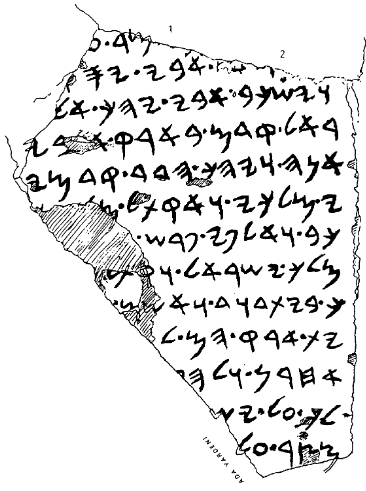
1. . . .
2. . . . my father went up
3. . . . and my father died, he went to [his
fate. . . Is-]
4. . . . rael formerly in my father’s land. . .
5. I [fought against Israel?] and Hadad
went in front of me. . .
6. . . . my king. And I slew of [them X
footmen, Y cha-]
7. riots and two thousand horsemen. . .
8. the king of Israel. And [I] slew [. . . the kin-]
9. g of the House of David. And I put. . .
10. their land. . .
11. other. . . [. . . ru-]
12. led over Is[rael. . . ]
13. siege upon. . .
Seals of Biblical Persons
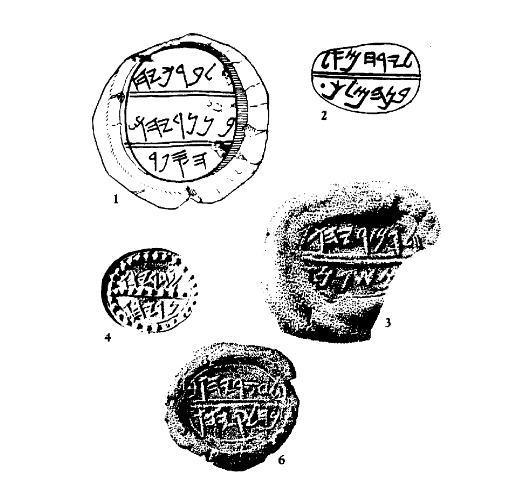
When letters and official documents were sent to someone, they were normally sealed with a wax or clay seal bearing the writer’s imprint. This normally had the writer’s name and title along with a geometric design. Some of the clay seals have survived and been found (although the documents to which they were once attached have long since crumbled away). Some of them are shown on the following page. These apparently belonged to the following people.
1. Baruch, son of Neriah Jer 36:4 (Jeremiah’s scribe)
2. Yerahmeel, son of the king Jer 36:26 (near Baruch seal)
3. Gemariah, son of Shaphan Jer 36:10
4. Seriah, son of Neriah Jer 51:59 (Baruch’s brother)
5. Azariah, son of Hilkiah 1 Chr 6:13 (son of high priest)
6. Azaliah, son of Meshullam 2 Kgs 22:3
All of these seals have been dated to around 600 BC, exactly the right time according to the Bible’s chronology.
In fact, two seals belonging to Baruch, son of Neriah have been found. One of them also showed a fingerprint, perhaps the mark of Baruch himself.
Nebuchadnezzar’s bricks
Many bricks have been found in Babylon bearing the following inscription Nebuchadnezzar, king of Babylon, who provides for Esagila and Ezida, the eldest son of Nabopolassar, king of Babylon, am I.
(Esagila and Ezida were temples in Babylon.) Until these bricks were found early this century, the name Nebuchadnezzar was unknown outside the Bible.
Babylonian chronicle
The Babylonian chronicle was also found and provides a description of Babylon’s attack on Jerusalem in 598–597 BC which agrees exactly with the biblical description in 2 Kings 24:10–17.
Babylonian chronicle
Seventh year: In the month of Kislimu, the king of Akkad [Babylon] called up his army, marched against Syria [lit. Hattu-land], encamped against the city of Judah and seized the town on the second day of the month Adar. He captured the king. He appointed there a king of his own choice. He took much booty from it and sent [it] to Babylon.
Nebuchadnezzar recorded the date as the 2nd of Adar in his 7th year He also recorded the dates of astronomical events such as solar eclipses which can be accurately calculated and so the Babylonian calendar can be synchronized with our modern calendar. In this way, the date of the attack on Jerusalem is calculated to be 16 March, 597 BC.
Jehoiachin in Babylon
The Bible describes Jehoiachin king of Judah being taken captive to Babylon where he was imprisoned. Many years later, the Bible says he was released and fed by the king of Babylon (2 Kings 25:27–30). Archaeologists have found receipts for delivery of oil to the king’s household in Babylon. One receipt listed Jehoiachin as receiving some of the king’s oil.
Deliveries of oil to royal household:
1½ sila for 3 carpenters from Arvad, ½ sila each
11½ sila for 8 ditto from Byblos, 1 sila each
3½ sila for 7 ditto, Greeks, ½ sila each
½ sila to Nabu-etir the carpenter
10 sila to Jehoiachin, the son of the king of Judah
2½ sila for the 5 sons of the king of Judah through Qana’a
Sheep’s liver
Nebuchadnezzar could not decide whether to attach Rabbah, the capital city of the Ammonites, or Jerusalem, the capital city of the Jews. In Ezekiel we read Mark out one road for the sword [of the king of Babylon] to come against Rabbah of the Ammonites and another against Judah and fortified Jerusalem. For the king of Babylon will stop at the fork in the road, at the junction of the two roads, to seek an omen: he will cast lots with arrows, he will consult his idols, he will examine the liver. (Ezekiel 21:20–21)
Thus he used a number of methods of diviniation to determine which city to attack. But how did he “examine the liver”?
Archaeologists have discovered numerous clay models of sheep’s livers. These appear to have been used to teach student astrologers. They are divided into 55 different parts and it is thought that the future was predicted based on which part of the liver was infected with parasites—rather like reading tea leaves!
These few examples show that the Bible is accurate, in both thehistory it records and its preservation through time. In fact, there has not been any archaeological find that contradicts the Bible. But there have been many to support it.
The Bible and modern medicine
Moses led the Israelites out of slavery in Egypt in about 1445 BC. Having crossed the Red Sea, they camped at Mt Sinai where God gave Moses the laws which were to form the basis for the new nation. Amongst other things, the laws covered cleanliness, morality, ethics and hygiene. Although it was not intended to be a scientific document, the Law of Moses outlined many provisions that are now recognized as important to the health of the Israelites. They could not have known this at the time. So these provisions provide further evidence that the Bible comes from God.
1. Before the improved preparation and refrigeration of foods, eating pork and seafood led to intestinal problems and frequent food poisoning. The Law of Moses prohibited these foods (Leviticus 11:4–8,10–20).
2. The Law of Moses emphasises (Leviticus 11:32–38)
(a) washing of hands and food
(b) regular use of running water (not stagnant)
(c) contaminated implements being scoured before re-use or broken
3. Until relatively recently, it was common for excrement to be dumped into the streets. Flies bred in the filth and spread intestinal diseases that killed millions. Diseases such as cholera, dysentery and typhoid fever took a heavy toll of lives. But none of these things were problems to the Israelites. God had given them the following law.
Designate a place outside the camp where you can go to relieve yourself. As part of your equipment have something to dig with, and when you relieve yourself, dig a hole and cover the excrement. (Deuteronomy 23:12–13)
4. Treatment of wounds was also based on hygienic protection. See Leviticus 15:4–12.
5. The laws of leprosy in Leviticus 13 required careful isolation of infection. Medical historians regard this as the first model of a sanitary legislation—thousands of years before the scientific basis for infection control was understood.
Contemporary Egyptian medicine
Compare the Law of Moses with Egyptian medical practice at the time. The Papyrus Ebers provides the following advice.
• To prevent hair from turning grey, anoint it with the blood of a black calf which has been boiled in oil or the fat of a snake.
• To cure blindness, mix pig’s eyes, antimony, red ochre and honey and pour into the sufferer’s ear.
• For an embedded splinter, apply worm’s blood and asses’ dung.
No doubt, the Israelites were familar with these “treatments” having lived in Egypt.
Resurrection of Jesus
Perhaps the most amazing claim in the whole Bible is that Jesus rose from the dead. If the Bible is inspired, this claim must be true. On the other hand, if Jesus did not rise from the dead, the Bible cannot be the word of God.
The resurrection is extremely important to the Christian faith. Professor Josh McDowell has written
. . . the resurrection of Jesus Christ is one of the most wicked, vicious, heartless hoaxes ever foisted upon the minds of men, or it is the most fantastic fact of history.
Josh McDowell,
Evidence That Demands a Verdict
The whole of Christianity hangs on the resurrection. Without it, there is no hope of salvation or hope for the future. The apostle Paul wrote
If Christ has not been raised, your faith is futile; you are still in your sins. (1 Corinthians 15:17)
Jesus . . . was delivered over to death for our sins and was raised to life for our justification. (Romans 4:24–25)
It was also a major part of the message that the apostles taught (see Acts 2:24,32; 4:1–2; 17:18; etc.) So it is important to consider the evidence for the resurrection of Jesus.
What happened. . .
1. Joseph asked Pilate for Jesus’ body (Matthew 27:57–58; Mark 15:42–45; Luke 23:50–52; John 19:38)
2. Joseph and Nicodemus laid him in a tomb, but because it was the Sabbath they did not anoint him. Some women saw where he was laid. (Matthew 27:59–61; Mark 15:46–47; Luke 23:53–56; John 19:39–42)
3. The tomb was blocked with a large stone across its entrance. (Matthew 27:60; Mark 15:46)
4. The Jewish leaders asked for a Roman guard to be placed on the tomb. The guard was granted and the tomb was officially sealed. (Matthew 27:62–66)
5. The women came back later to anoint him but found the stone moved and the grave empty. Two angels appeared to them and explained that Jesus had risen from the dead. Peter and John also saw the empty tomb. (Matthew 28:1–7; Mark 16:1–8; Luke 24:1–8; John 20:1–9)
6. The Jewish leaders bribed the soldiers not to tell anyone what had happened, but to say they had fallen asleep and the disciples had stolen the body. (Matthew 28:11–15)
7. Jesus appeared to some of them, and later to the disciples as a group. They were reluctant to believe, but were convinced when they saw him. (Matthew 28:8–20; Mark 16:9–14; Luke 24:9–49; John 20:10–31; Acts 1:3–4)
Eyewitnesses
A large number of people claimed to see Jesus after his resurrection. Those we know about are listed below.
• Mary Magdalene
• Women returning from tomb
• Peter
• Disciples on road to Emmaus
• Apostles, Thomas absent
• Apostles, Thomas present
• Seven by Sea of Galilee
• 500 believers at one time
• James
• Eleven
• At ascension
• Paul
• Stephen
• Paul in temple
• John on Patmos
In fact, many of them were initially skeptical and Jesus had to give “many convincing proofs that he was alive” (Acts 1:3). The apostle Thomas was not prepared to believe until he saw Jesus for himself (John 20:25). The fact that they all did eventually believe, shows that there must have been convincing evidence.
Their eye-witness accounts were an important part of the gospel message (Acts 2:32; 3:15; 10:39–41; 1 Corinthians 15:3–8).
Persecution
The disciples had every reason not to believe. By acknowledging their faith in the resurrection, they became subject to fierce persecution. They must have been absolutely convinced that Jesus had risen from the dead. They had no doubts. Anybody with doubts would not have willing suffered as they did.
Compare the behaviour of the apostles before and after Jesus resurrection. They had deserted and fled when Jesus was arrested (Matthew 26:56). Peter crept back but when questioned he denied he had ever known Jesus (John 19:15–27). The others did not have the courage to appear at all. Less than three months later, they were all willing to stand up in public and proclaim the resurrection. They rejoiced when they were persecuted (Acts 4:1–21; 5:29–42).
It is amazing to think that a defeated little band of cowards meeting in an upper room one day could, a few months later, be a powerful force withstanding great persecution. Something had convinced these men.
Simon Greenleaf, Royall Professor of Law at Harvard University, has written
They had every possible motive to review carefully the grounds of their faith, and the evidences of the great facts and truths which they asserted . . . It was therefore impossible that they could have persisted in affirming the truths they have narrated, had not Jesus actually risen from the dead.
The missing body
Perhaps more than any other reason, the missing body provides ample evidence for the resurrection. The Jews desperately wanted to stop the young Christian movement. They could have done so easily by simply producing the body. In his first public speech in Jerusalem, Peter spoke about Christ’s resurrection (Acts 2:24,32). But no one came forward to contradict Peter’s claim.
After all, the tomb had been under guard (Matthew 27:62–66; 28:11–15). Because of the guard, the body could not have been taken by anyone other than the Jews or Romans, and apparently neither knew where it was. Therefore Jesus must have been raised.
The stone
A very large stone was placed across the entrance to the tomb (Matthew 27:60; Mark 16:4). Such tombs were very common in Israel at that time and many have been studied by archaeologists. They have concluded that the stone probably weighed between one and two tonnes and that the stone stood on a ramp which was gently inclined toward the tomb. So to seal the tomb, the stone was pushed down the slope. But to open the tomb was very difficult and required several strong men.
The Roman Guards
The Jewish leaders asked Pontius Pilate (the Roman procurator) for military guards to be posted at the tomb so Jesus’ body could not be stolen (Matthew 27:62–65). It is estimated that a Roman guard unit consisted of between 4 to 16 soldiers. Once the guards were posted, no one would dare attempt to remove the stone covering the entrance.
But while the Roman soldiers were on guard, an angel appeared (Matthew 28:2–4), caused an earthquake and rolled back the stone. When the chief priests heard what had happened, they attempted a cover up. They bribed the guards to say the disciples had stolen the body during the night while the guards were asleep!
Leaving a night watch or sleeping while on guard required the death penalty under Roman law. (Compare the jailer’s reaction in Acts 16:25–28 when he thought his prisoners had escaped.)
Furthermore, the tomb had been officially sealed (Matt 27:66) and to break the seal without permission would also have been punishable by execution. Even if the disciples could have rolled back the huge stone without waking the Roman soldiers, would they have been willing to defy the Roman authority and fight the guards just to steal the body? Given their actions a few days earlier, it is hardly likely!
Some theories to explain it away
Swoon theory Jesus could have fainted, revived and escaped from the tomb.
Hallucination theory All the eye-witnesses hallucinated.
Wrong tomb theory The disciples went to the wrong tomb.
Hoax theory The disciples stole the body.
Theft theory Thieves stole the body
Official coverup theory Either the Romans or Jewish authorities took the body.
Can you explain why each of these theories cannot be true?
Conclusions
All the evidence points to the truth of Jesus’ resurrection. Three days after he was dead and buried, Jesus was resurrected as he said he would be (Matthew 16:21; 28:6).
We can have hope and faith as a result. Jesus’ rising from the dead is evidence of a future resurrection of faithful people (1 Corinthians 15:12–22,51–55).
Homework
Read John chapter 20
1. How do these verses show that the disciples were not expecting the resurrection of Jesus?
2. What do we learn from the grave clothes being found neatly folded (v7)?
3. Does v19 show the disciples were still doubting? What convinced them that Jesus was truly raised from the dead?
4. What evidence is there in this passage that Jesus did not have an ordinary body after his resurrection?
5. Why is Christ’s resurrection so important if the Bible is to be believed?