
Session 5
Bible prophecy
Another remarkable evidence for the inspiration of the Bible is prophecy. The Bible contains many prophecies about Israel and the surrounding nations. Some were fulfilled almost immediately, some were fulfilled hundreds of years later, some are still being fulfilled today, and some are yet to be fulfilled. Fulfilled prophecy shows that the Bible must come from a powerful God who knows the future.
Predicting the future
People have always wanted to predict the future to reduce their fear and anxiety about the unknown and an uncertain tomorrow. This desire has been satisfied by priests, astrologers, prophets, fortune tellers, and the like since the dawn of civilization. In Bible times, there was a range of methods used.
- Augury: using animal entrails
- Hepatoscopy: using animal livers
- Auspices: using the flight of birds
- Astrology: using stars and planets
- Oracles: often ambiguous answers by priests or priestesses to specific questions
Today we have
- horoscopists
- tarot card readers
- palmists
- tea leaf readers
- clairvoyants
Nostradamus, who was born in 1503, is one who claimed to be a prophet. He wrote a large number of quatrains (four line paragraphs) which together formed his book of prophecy. The quatrains are very vague and mystical. Despite this many people have endeavoured to interpret them as prophecies of significant events such as World War 2 or the deaths of famous people. However, such interpretations are highly subjective.
Bible prophecy is different. It is clear and specific and usually not open to interpretation. The Bible claims that the prophets were inspired by God in what they wrote:
Prophecy never had its origin in the will of man, but men spoke from God as they were carried along by the Holy Spirit. (2 Peter 1:21)
Bible prophets
A Bible prophet did not just foretell the future, but was God’s messenger in commanding, encouraging and warning his people. Sometimes this involved relaying God’s plans and intentions for the future, but sometimes a prophet’s message did not involve any prediction. However, in this session, we will look only at prophecies which predicted events in the future.
It is important to see prophecy from God’s perspective. The Bible portrays him as the controller of future events. He knows the future because he will make it happen. In this way, Bible prophecy is history in advance.
There are different types of prophecy. Some are “short-term” and fulfilled in the lifetime of the prophet. Many are “long-term” and extend beyond the prophet’s lifetime. A prophet often proclaimed a combination of both, the short-term fulfillment providing evidence of the truth of the long-term prophecy. Many prophecies have a dual fulfillment, a partial short-term
fulfillment and a more complete long-term fulfillment.
Two tests were applied to see if a prophet was genuinely from God. The
first test concerned the teaching of the prophet:
If a prophet, or one who foretells by dreams, appears among you and announces to you a miraculous sign or wonder, and if the sign or wonder of which he has spoken takes place, and he says, “Let us follow other gods” (gods you have not known) “and let us worship them”, you must not list to the words of that prophet or dreamer. The Lord your God is testing you to find out whether you love him with all your heart and with all your soul. (Deuteronomy 13:1–3)
Isaiah also stated
When men tell you to consult mediums and spiritists... To the law and to the testimony! If they do not speak according to this [God’s] word, they have no light. (Isaiah 8:19–20)
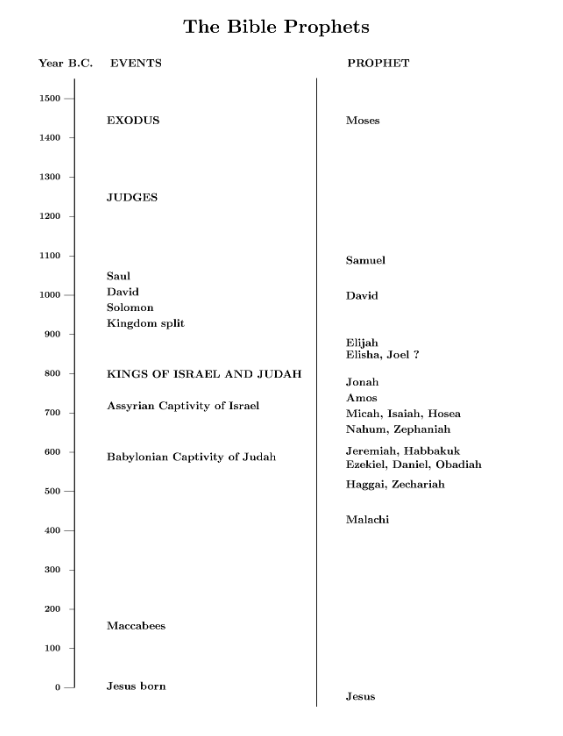
The second test was whether the prophet had shown the ability to predict the future before.
You may say to yourselves, “How can we know when a message has not been spoken by the Lord?” If what a prophet proclaims in the name of the
Lord does not take place or come true, that is a message the Lord has not spoken. That prophet has spoken presumptuously. Do not be afraid of him. (Deuteronomy 18:21–22)
The prophet... will be recognized as one truly sent by the Lord only if his prediction comes true. (Jeremiah 28:9)
So a true prophet was one who taught things consistent with the rest of God’s revelation and who gave a short-term prophecy which came true.
The accurate fulfillment of Bible prophecies gives great credibility to the Bible’s claim of inspiration. It also gives us confidence in prophecies not yet fulfilled.
Prophecies about Israel
Israel is the subject of more prophecies than any other nation, simply because the Jews are God’s special people. Their entire history has been foretold including events which have taken place in the 20th century. The existence of the people of Israel, the Jews, and the existence of the nation in its biblical land can be considered to be evidence for the reliability of the Bible.
In 1897 at the first Zionist Congress in Basle, Switzerland, a Jew named Theodore Herzl proposed a Jewish homeland in the land known at that time as Palestine. It was under the control of Turkey and formed part of the Ottoman empire. At that time, there was only a handful of Jews living in Palestine. With the Turks in control, Jews weren’t welcome.
Just 20 years later, at the end of World War I, the British evicted the Turks from Palestine and liberated Jerusalem. For the next 20 years, Britain clung tenaciously to the mandate over Palestine given it by the League of Nations (the forerunner to the United Nations). Slowly, Jews began to move back to the land of their ancestors. The pace of immigration increased rapidly after World War II and the atrocities of Nazi Germany, and many surviving Jews returned to Palestine. The enormity of Jewish
suffering in what was to become known as “the Holocaust”, and the concern and guilt of many nations, led to the establishment of the State of Israel, proclaimed on 15 May 1948.
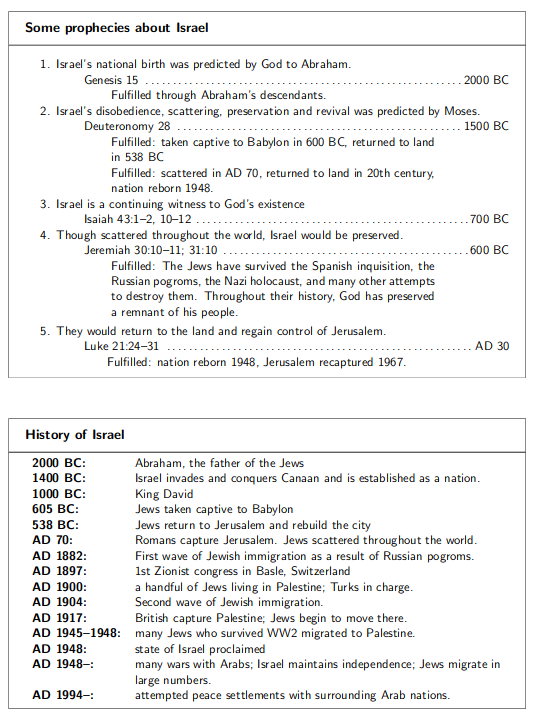
This new State of Israel was established nearly 1900 years after the Jews
had been exiled by the Romans.
The nation has survived against incredible odds with its hostile neighbours seeking to destroy it on numerous occasions. The most notable of these wars occurred in 1967 when an extraordinary event took place. The city of Jerusalem, divided since partition of Palestine in 1948, and out of Jewish control for nearly 1900 years, was once again united and brought under sovereign Jewish control.
Why has Israel survived? Because God said it would. Consistently through the prophets, God repeated his intention that despite their wickedness and despite his punishment of them, ultimately he would remember the promises which he made to their faithful ancestors, and bring them again to their own land.
The attempts to bring lasting peace to the Middle East will certainly fail. One of the consistent stumbling blocks to peace in the region is the status of the city of Jerusalem. God, through the prophet Zechariah, says of Jerusalem:
I am going to make Jerusalem a cup that sends all the surrounding peoples reeling... I will make Jerusalem an immovable rock for all the nations. All who try to move it will injure themselves. (Zechariah 12:2–3)
Ezekiel’s vision of the valley of dry bones
Reference: Ezekiel 37:1–14
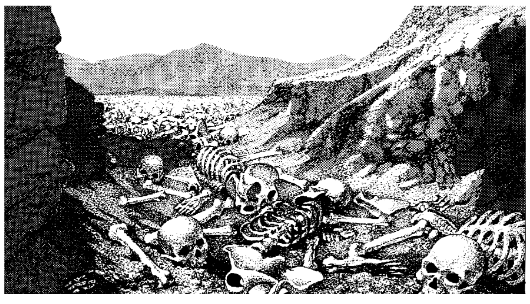
Ezekiel prophesied in about 590 BC when the nation of Israel was in captivity in Babylon. He gave many fascinating prophecies, including this vision of a valley of dry bones. The well-known Negro spiritual song “Dem dry bones” refers to this prophecy. It is a very clear prophecy with each element of the prophecy being clearly explained.
Ezekiel’s vision was of a collection of dry bones lying at the bottom of a valley. The bones come together and were covered with tendons, flesh and skin but the bodies which were formed remained dead. Then breath entered the bodies and they become a vast living army.
In verses 11–14, the prophecy is explained. It depicts Israel’s
revival in two stages.
| Vision | Meaning |
| bones | house of Israel |
| dried bones | hope gone, cut off |
| bones come together | Jews return to land of Israel |
| breath in bones | spirit of God in Jews |
The prophecy is unambiguous and clearly explained. The Jews were to be gathered out of many nations around the world and become one nation in the land their ancestors originally lived in, the land of Israel. This is precisely what has happened over the past century.
No other nation has maintained a national identity after more than 1800 years of exile. But no other nation has had these prophecies made concerning their history. Other nations which have been dispossessed of their land have lost their identity within a few years. What has happened to Israel is extraordinary. The Jews are a standing miracle, a monument of fulfilled prophecy. The fact that their history was predicted so accurately shows the Bible is God’s book.
We have only seen the first stage of Ezekiel’s prophecy fulfilled. Israel has returned to their land as predicted, but they remain a secular nation uncommitted to God. God’s spirit does not yet dwell in them. A survey conducted in the mid-1980s revealed that most Israelis do not consider that God is responsible for their current position and survival in the land. These prophecies indicate they are yet to become a religious nation relying on God and obeying him.
Luke 1:30–33
How many common ideas can you fi nd between Ezekiel 37:24–28 and Luke 1:30–33?
The last stage in the prophecy is described in verses 24–28. After the Jews turn back to God, they will have a new king “David” who will rule over them forever in peace. Luke 1:30–33 makes it clear that this king will be Jesus who was a descendant of the earlier King David of Israel. He is to sit on David’s throne in Jerusalem.
We can be confident that the Jews will turn back to God and that Jesus will return to be king because the first part of this vision has been fulfilled. The Jews are back in the promised land as predicted in the Bible.
Vision of world empires
One night about 600 BC, Nebuchadnezzar, King of Babylon, had a dream. The dream seemed unusually vivid and it concerned him. First Daniel told the King what the dream was (see Daniel
2:31–35). Nebuchadnezzar had seen a large statue composed of different metals. As he watched, he saw a stone which had been cut (but not by human hands) strike the image on the feet and
destroy it. The metals broke in pieces while the stone grew into a great mountain and filled the whole earth.
Then Daniel told him what it meant (see Daniel 2:36–45). The four metals of the image represented four empires that would arise. The statue’s head of gold represented Nebuchadnezzar himself and his kingdom of Babylon. The other empires were Medo-Persia, Greece and Rome.
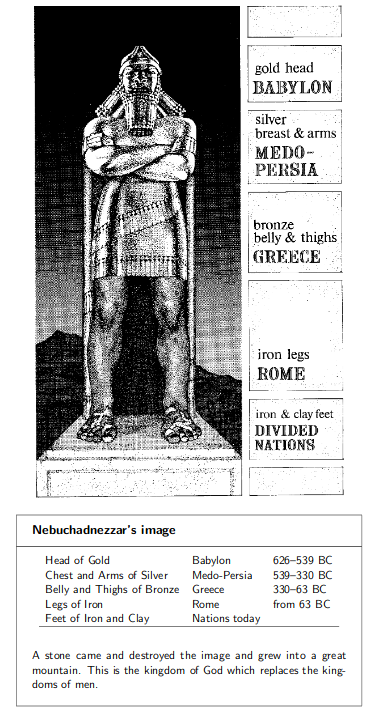
The history of Israel has followed the pattern of this prophecy. From the time of Daniel, there were four empires which ruled Israel: Babylon, Medo-Persia, Greece and Rome. After the Roman empire, the Jews were scattered around the world. Now that Israel is back in their land, there is no dominant empire, but a mixture of strong and weak nations represented by the statue’s feet of iron and clay.
The one phase of the prophecy yet to be fulfilled is the shattering of the statue by the rock cut out of a mountain without human hands and the mountain which fills the earth. Daniel says this represents the kingdom of God which replaces the kingdoms of men. Because the rest of the prophecy has been fulfilled, we can be confident that this last phase will be fulfilled too.
So the prophecy ends with a similar scene to Ezekiel’s valley of dry bones: a time when God’s kingdom will be in the earth. Putting the two prophecies together we can see that this will occur when Jesus returns to be king on David’s throne in Jerusalem, ruling in righteousness and peace
Homework
1. Read Daniel 2 again.
(a) Why is the whole image broken in pieces by the stone rather than just the last kingdom?
(b) What differences do you find between the kingdoms of the world that compose the image and the kingdom symbolized by the stone?
(c) What was the purpose of the dream for (i) Nebuchadnezzar, (ii) Daniel and his friends, (iii) us?
2. Read Ezekiel 36:16–38
(a) List the elements of this prophecy which have been fulfilled.
(b) List the elements of this prophecy which have not yet been fulfilled.
(c) How do your two lists relate to the prophecy of the valley of dry bones in the next chapter?