
The Office of Priesthood
The Bible teaches that there is a great gulf between the God of heaven, the Almighty Creator, and fallen mankind, the result of man’s rebellion and sin. God declares: “For as the heavens are higher than the earth, so are My ways higher than your ways, and My thoughts than your thoughts” (Isa. 55:9). God is “of purer eyes than to behold evil”, while fallen man “at his best state is altogether vanity” (Hab. 1:13; Ps. 39:5, AV). Thus men have long recognised the need for a go-between, a mediator who could intercede with God on their behalf. Job lamented: “Oh, that one might plead for a man with God, as a man pleads for his neighbour!” (Job 16:21). And God answered that need in the appointment of priests.
There are hints in Genesis of family priests in the age of the Patriarchs; and, when God established Israel as His chosen people, He instructed Moses to appoint as priests for the nation the house of Aaron, from the tribe of Levi: “Now take Aaron your brother, and his sons with him, from among the children of Israel, that he may minister to Me as priest” (Ex. 28:1). They were to wear special garments for the service of the tabernacle, the portable place of worship, and were consecrated by Moses for their office (chs. 28, 29).
The priests’ principal duties were to offer sacrifices daily and upon the appointed feast days, as acts of worship, so that God would, symbolically, dwell among His people (29:44,45) and so be accessible to their thanksgivings and their supplications for forgiveness. The process of obtaining forgiveness and reconciliation with God involved the sacrifice of a specified animal as a sin offering. In this the priest acted as mediator, offering the blood upon the altar: “So the priest shall make atonement for him concerning his sin, and it shall be forgiven him” (Lev. 4:26,31,35, etc.).
The limitations of this system of priesthood are made clear in the letter to the Hebrews. First, the priests were themselves sinners, in need of forgiveness: “if the anointed priest sins, bringing guilt on the people, then let him offer to the LORD for his sin . . .” (Lev. 4:3-12). Consequently, they themselves were mortal: “there were many priests, because they were prevented by death from continuing” (Heb. 7:23). Secondly, it was necessary to repeat the offerings again and again, each time a new sin was committed, showing that they did not truly deal with men’s sins: “For it is not possible that the blood of bulls and goats could take away sins . . . And every priest stands ministering daily and offering repeatedly the same sacrifices, which can never take away sins” (10:4,11).
A superior priesthood
The Levitical system of priesthood is thus seen to have been a temporary one, foreshadowing the true means by which God would choose to offer men complete and lasting forgiveness, through the sacrifice of His Son, Jesus Christ. He would be both perfect sacrifice and immortal priest. Jesus made both possible since, though fully sharing the nature of mortal man, he was totally submissive to his Father’s will: “though he was a Son, yet he learned obedience by the things which he suffered. And having been perfected, he became the author of eternal salvation to all who obey him” (5:8,9).
The priesthood of Jesus is of a superior order, established by God and confirmed by oath in a remarkable psalm of David: “The LORD said to my Lord, ‘Sit at My right hand, till I make your enemies your footstool’... The LORD has sworn and will not relent, ‘You are a priest forever according to the order of Melchizedek’” (Ps.110:1,4). This Melchizedek was a king and also priest in Salem (Jerusalem), long before the time of Aaron’s priesthood. He encountered Abraham and pronounced a blessing upon him: “Then Melchizedek king of Salem brought out bread and wine; he was the priest of God Most High. And he blessed him and said: ‘Blessed be Abram of God Most High, possessor of heaven and earth; and blessed be God Most High, Who has delivered your enemies into your hand’” (Gen. 14:18-20).
This ‘order’ thus combines the roles of king and priest; Jesus has been Divinely appointed High Priest, superior even to Melchizedek (Heb. 3:1), and future ruler of God’s Kingdom on the earth, from David’s throne in Jerusalem (Lk. 1:31-33). He has been granted immortality and exalted to heaven itself, and now exercises an eternal priesthood, in the very presence of God: “For Christ has not entered the holy places made with hands, which are copies of the true, but into heaven itself, now to appear in the presence of God for us” (Heb. 9:24).
Jesus’ position as High Priest is emphasised in the letter to the Hebrews because its recipients, first-century Jewish Christians, were in danger of turning back to Judaism and the Levitical priesthood of the temple, which had now been superseded. It was necessary to show them that Jesus is the one person in all history worthy to perform this role, making redundant any need for an earthly priesthood. This was demonstrated by the action of Caiaphas, the Jewish high priest who condemned Jesus: upon Jesus’ acknowledgement that he was the Messiah, the Son of God, Caiaphas tore his clothes (Mk. 14:63), an action forbidden under the Law (Lev. 21:10), and thus symbolically brought the Levitical priesthood to an end.
At the same time, the prayer of Jesus recorded in John 17, delivered possibly in the temple courts shortly before his arrest and trial, has often been referred to as the prayer of the High Priest. In it the Lord makes intercession for his disciples and for their unity in him: “Holy Father, keep through Your name those whom You have given me, that they may be one as we are” (v. 11).
A great High Priest
In the grace of God, true believers in the hope of Israel have been provided with a sinless advocate, a great High Priest in the very presence of God. The ‘priests and pastors’ of Christendom have no Scriptural sanction for their claim to intercede for men and women: “For there is one God and one Mediator between God and men, the Man Christ Jesus, who gave himself a ransom for all, to be testified in due time” (1 Tim. 2:5,6).
Furthermore, he is a mediator fully aware of our trials and problems: “For we do not have a High Priest who cannot sympathize with our weaknesses, but was in all points tempted as we are, yet without sin. Let us therefore come boldly to the throne of grace, that we may obtain mercy and find grace to help in time of need” (Heb. 4:15,16). This is far from a theoretical or abstract concept: the priesthood of Jesus is real and powerful in the life of his disciples as he pleads their cause before the throne of the Father.
The Organisation of the Early Ecclesia
Having seen that the Jewish priesthood was replaced by the work of Christ, we must now turn to consider how the early believers organised themselves. Did the Lord's apostles command the establishment of a human priesthood modelled on that of Christ's? Did they instruct that special buildings, intricately decorated, should be erected; that there should be special robes, or special phraseology to make worship acceptable? Were there to be special functions for certain believers?
The New Testament account of the early Christian church reveals an active, lively, and rapidly growing community. Although believers performed many different functions, there were no distinctions in terms of status:
"For as in one body we have many members, and all the members do not have the same function, so we, being many, are one body in Christ, and individually members one of another" (Romans 12:4,5).
Through all that was written during this exciting period, and while the gospel message was scorching through the Mediterranean world assisted by the communication systems provided by the Roman Empire, there was clearly great concern that no one person, or group of people should dominate the fellowship of believers. To suggest otherwise would effectively dethrone their Lord, for:
"Christ is the head of the church, his body, and is himself its Saviour" (Ephesians 5:23).
Service is the Keynote
Jesus' own words to his followers should be the guide in these matters. He taught all of his disciples to be servants, and there was to be no differentiation in terms of rank. He set the example himself when he washed the feet of his disciples-in his day the most menial task of the most insignificant slave: "I have given you an example, that you also should do as I have done to you" (John 13:15). He also warned his followers about the dangers of treating some men or women differently from others. They had seen, as he had, the corruption of the Jewish leaders in their day. Jesus warned his own followers not to fall into the same trap:
"You are not to be called rabbi, for you have one teacher, and you are all brethren. And call no man your father on earth, for you have one Father, who is in heaven. Neither be called masters, for you have one master, the Christ" (Matthew 23:8-10).
Elsewhere in his teaching, Jesus upheld the family unit, and spoke about the need for children to respect their parents. He was therefore clearly talking on this occasion about their religious organisation needing to be founded as a brotherhood. His words here concerning fathers relate to the practice of calling religious leaders "father", showing how alien it is to Christ's ideal of the relationship between believers. To do so in the face of Jesus' own teaching is an affront to the majesty of God Himself.
Servant Leadership
Interest in servant leadership has increased in recent years. Conferences, courses, publications, and programs promoting servant leadership have multiplied. Most of the companies at the top of Fortune Magazine’s best companies to work for in America have adopted some aspects of Servant Leadership. There are at least two reasons for its resurgence:
-
Servant Leadership is part of the larger movement away from command-and-control leadership towards participatory and process-oriented leadership in the IT-based economy, and
-
Service Leadership holds the promise of an ethical and socially responsible management and leadership as an antidote to corporate scandals.
In Christadelphian community, the main appeal of Servant Leadership is that it is biblically based and modelled after Jesus Christ. Secondly, it provides a lofty vision and a powerful purpose for Christian ministry.
The Practice of Servant Leadership
No one has ever questioned the value of Servant Leadership. How can one deny the benefits of having competent leaders who are also caring, honest and empowering? However, many leaders, including Christian leaders, have questioned the practicality of implementing Servant Leadership within their work environment.
One key question is how power and servant leadership interact. Do you have to give up power to be a servant leader? The obvious answer is no. By definition, leaders possess various bases of power, without which no leader can function.
The paradox of servant leadership
The concern that servant leadership means giving up power stems from the seeming oxymoron that one can be a humble servant and at the same time wield a big stick. This apparent contradiction in terms can be easily resolved by recognizing that good leaders, including servant leaders, use a variety of social powers; they will resort to coercive power only in dealing with immature and irresponsible workers. We also need to address the underlying anxiety of losing power and losing the coveted position of leadership. Leaders, who are opposed to the Servant Leader practice of sharing power and empowering others, fear that subordinates may use this newfound freedom and power against the leadership. In order to feel secure in their position, they resort to coercive tactics to keep subordinates under control. Paradoxically, abuse of power only increases their sense of insecurity, because they will soon discover that their potential to attract and influence followers actually decreases in proportion to their attempt to control through intimidation, deception and manipulation. The reality is that no one likes to be controlled, and therefore no one can control others. The psychology of reactance is an important consideration. The paradox of Servant Leadership is that leaders can actually increase their potential to influence through intentional vulnerability and voluntary humility, as demonstrated by Jesus, who “made himself nothing, taking on the very nature of a servant... he humbled himself and became obedient to death, even death on a cross.” (Phil.2: 7-8). The emptying (kenosis) of himself did not diminish his leadership position, nor did it prevent him from exercising his power as Lord over nature, over diseases, and over the religious establishment. Right after washing his disciples feet (John 13:5), Jesus said: “You call me Teacher and Lord, and rightly so, for that is what I am. Now that I, your Lord and Teacher, have washed your feet, you also should wash one another’s feet” (John 13:13). Jesus is equally at home with the exercise of power and the humility of servanthood. Since we are called to follow his steps, we need to find out both theoretically and practically how servanthood and leadership co-exist and how humility and power interact with each other.
A Multidimensional Model of Servant Leadership
Table1 shows the original conceptual framework Page and Wong (2000) have developed. It is a multidimensional model, which recognizes 12 Servant Leadership attributes based on prior literature and the authors’ personal experiences in leadership. These attributes can be conceptually classified into four orientations, which cover the four fundamental, functional processes in leadership according to the management literature.
Table 1 A Conceptual Framework for Measuring Servant Leadership
-
Character-Orientation (Being: What kind of person is the leader?)
Concerned with cultivating a servant’s attitude, focusing on the leader’s values, credibility and motive.
• Integrity
• Humility
• Servanthood
-
People-Orientation (Relating: How does the leader relate to others?)
Concerned with developing human resources, focusing on the leader’s relationship with people and his/her commitment to develop others.
• Caring for others
• Empowering others
• Developing others
-
Task-Orientation (Doing: What does the leader do?)
Concerned with achieving productivity and success, focusing on the leader’s tasks and skills necessary for success.
• Visioning
• Goal setting
• Leading
-
Process-Orientation (Organizing: How does the leader impact organizational processes?)
Concerned with increasing the efficiency of the organization, focusing the leader’s ability to model and develop a flexible, efficient and open system.
• Modelling
• Team building
• Shared decision-making
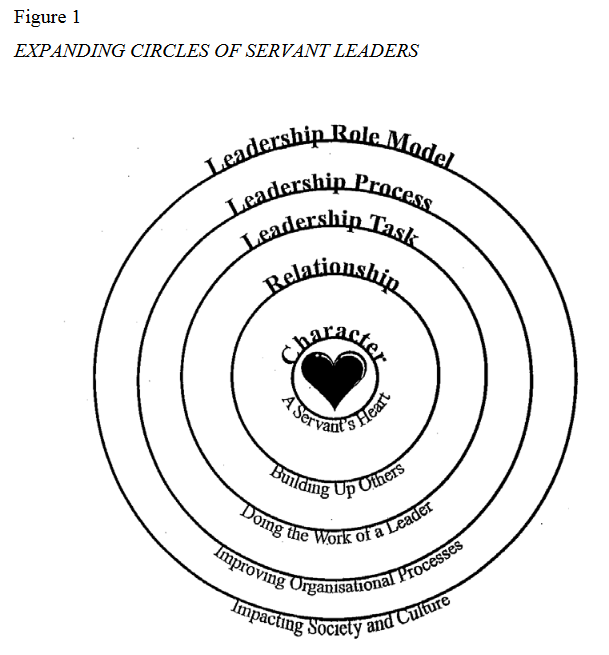
The impact of the multidimensional model can be represented as ever expanding concentric circles as shown in Figure 1. The heart and soul of Service Leadership is concerned with the Character-orientation, to be followed by people-orientation, task-orientation, and process-orientation. These circles represent the sequence in the development, practice and influence of Service Leadership. According to this model, it is impossible for one to perform the leadership task as a Service Leader, unless one has developed a servant’ heart, and knows how to develop and empower others. The last circle indicates the wider impact of Service Leadership on society and culture.
The Family of Believers
The idea of a family is a very useful way of understanding how the early believers organised themselves in accordance with the advice of Jesus and his apostles. God was their Father, and the Lord Jesus Christ their Saviour, the head of their community. But like a normal, human family with older and younger members, where those who are more experienced take a greater share in the daily responsibilities, so in the early Christian congregations there were elder and younger members. Certain responsibilities were given to the elders, but they were not to lord it over the rest of the congregation. They were to "treat younger men like brothers... younger women like sisters, in all purity" (1 Timothy 5:1,2).
Yes, there were different tasks, and different responsibilities according to circumstance, but the first century congregations knew nothing of the distinction between priests and laymen, so common in today's churches. The selection of elders to look after each congregation was the responsibility of the members in that place. Paul wrote to Titus, in Crete, and told him to: "appoint elders in every town" (Titus 1:5). It would presumably have been possible for Paul to have given a list of appropriate names. But this would not have helped believers elsewhere, or in a later age. So that the task could subsequently be done by the members of any congregation, Paul set down the qualities that fit a man to be an elder:
"Men who are blameless, the husband of one wife, whose children are believers and not open to the charge of being profligate or insubordinate" (verse 6).
Elders, Bishops and Deacons
These elders, sometimes called "bishops" (meaning shepherds or overseers had, as we have seen, responsibilities towards their fellow believers. The bishop's role was that of a shepherd. He was not in Jesus' place in the community, but had to display the same concern for the "flock" - of which he was also a part.
Other tasks, also of service, were entrusted to men and women qualified to fulfil them. Whereas elders' responsibilities were directed more to the spiritual needs of believers, "deacons" were involved with their physical needs. In the New Testament only the Lord Jesus Christ is recognised as a priest. Nor do any of the descriptions of the work of elders, bishops or deacons suggest that these had any priestly function. None of the other church "offices" are Bible terms either: they have all been invented by men.
Nowhere do the Apostles mention the sort of building believers should meet in. On one occasion the apostle Paul joined a group of worshippers who met by the riverside. Everything he had to say about this group, and others like them, commends their practices. Nor are special clothes mentioned. The only time there are references to what worshippers should wear, there are strong indications that clothes in flamboyant colours or costly materials should be carefully avoided (1 Peter 3:3,4, for example).
Another distinction between clergy and laymen in many churches today is that the clergy receive payment for their work. In the first century, those involved in the spiritual welfare of the community were entitled in principle to material or financial support. The apostle Paul wrote to the Corinthians about this. He said: "Do we not have the right to our food and drink? The Lord commanded that those who proclaim the gospel should get their living by the gospel" (1 Corinthians 9:4-14). Nevertheless, Paul recognised the possibility of corruption entering into the community through this provision, and declared about himself: "I have made no use of any of these rights in my preaching I make the gospel free of charge... I do it all for the sake of the gospel, that I may share in its blessings" (verses 15-23).
The history of churches where payment has been made to its clergy unfortunately bears out the apostle's concerns. In the Middle Ages the churches were extremely corrupt, and many priests became infinitely more wealthy and powerful than the members of their congregations. The problem still exists today. Scandals involving church finances occur only too regularly. A return to the New Testament principle of "the right to food and drink" for those "who proclaim the gospel" would help to prevent many of these crimes.
The Work of the Apostles
It is important to recognise that these arrangements for each congregation to elect ministers (i.e., servants) from within its own membership were being made when the apostles of Jesus were still active among the infant church. In the absence of a reliable written account of the work and teachings of Christ (for the gospels were not widely available in their present form until towards the end of the first century A.D.), the apostles were inspired witnesses of Jesus' life, death and resurrection. On them rested the power of God, His Holy Spirit. It gave them ready recall of all that Jesus did and said; and by it they were able to work miracles to reinforce the truth of their teachings, as Jesus had.
Once the New Testament account was complete, man had in his possession, together with the books of the Old Testament, a book that contains all that is necessary to teach him about God's offer of salvation:
the holy scriptures... "are able to instruct you to salvation through faith in Christ Jesus" (2 Timothy 3:15).
Each believer becomes individually responsible to God for the answer he makes to the call of the gospel. As the Psalmist wrote: "None can by any means redeem his brother, nor give to God a ransom for him" (49:7) Through the word of God man learns of His offer of salvation. Others may assist him to grow in his understanding. But once he comes to an appreciation of the saving work of Christ and the faithful response he should make, he stands on his own before God. His only mediator is the Lord Jesus Christ.
Apostolic Succession
But, it has been argued, the apostles were leaders of the Church; they acted in Christ's place. To the extent that they witnessed to him, and preached the same gospel message, this is true. But the apostles, even though they had the power of the Holy Spirit, did not act as mediators on behalf of other men and women, as priests today claim for themselves. We have seen that the purpose of the Holy Spirit in the apostles' lives was to guarantee the truth of their witness. As this was no longer necessary once the scriptures were complete, there was also no need to provide for a succession of men to take on the role of apostles. Nowhere in the Bible record can we find apostleship being passed on to a new generation.
It is sometimes claimed that the practice of "laying on hands" provided divinely appointed successors to the apostles. But the term has a variety of meanings, many of them unrelated to the idea of succession, such as identification with an offering, or the award of a blessing.
When Moses was specifically commanded to appoint Joshua to succeed him, God said: "Lay your hand upon him… you shall invest him with some of your authority" (Numbers 27:18,19). The history of the nation soon shows that the people were to look upon Joshua as they had once viewed Moses. If the laying on of hands in the New Testament has only this special meaning, we should expect to find apostles being replaced as they died, if not before. But they were not. The apostle James died quite soon after the ascension of Jesus (Acts 12:2), and there is no mention of a replacement for him. We have already seen that the election and appointment of elders was made specifically with the consent and approval of each individual congregation, and not directly by the apostles.
After the Apostles
Evidence from early church history indicates that it was not until the middle of the second century A.D. that the practice developed of separating bishops from elders. Bishops were elevated to a position where their role was that of master or lord rather than servant. At about the same time there were signs of the emergence of a separate priesthood which began to assume certain features of the Jewish priesthood. Elaborate rituals developed connected with religious services and in the ordination of church officials. Soon there were the special buildings, clothing and language that so mark out much of religious activity today. Though contrary to Bible teaching, this was not a wholly unexpected development. Even during the period when the apostles were active there was a constant struggle to prevent the intrusion of both Jewish and pagan practices into the infant Christian community.
Jesus and his apostles warned about the emergence of "false teachers", "false prophets", and even of "false Christs", who would deceive many and turn away disciples after them (Matthew 24:4,5,11,24). Paul showed that false teachers would arise from within the church itself: "From among your own selves will arise men speaking perverse things, to draw away the disciples after them" (Acts 20:28-30). Towards the end of the first century, the apostle John wrote: "As you have heard that antichrist is coming, so now many antichrists have come" (1 John 2:18). The term "antichrist" refers not only to those who openly oppose Christ's teaching, but also to those who claim to represent him, yet who, by their teachings and practices, actually oppose him.
These warnings are just as important today. Any survey of the history of Christianity shows how the simple faith and practices of the apostles and their fellow believers have been corrupted. The only way to ensure compliance with them is to examine modern beliefs and behaviour in the light of Bible teaching.
Living Sacrifices
Learning that present believers do not act as priests, interceding or offering on behalf of others, we can recognise only the Lord Jesus Christ as priest for his church. However, there are aspects that formerly were part of the priesthood that believers now have to fulfil on their own behalf. As the Levites were "taken out" of Israel to serve God under the law of Moses, so the believers in Christ are "taken out" of the world to be a selected company to offer praise unto God:
"Through him (Christ) then let us continually offer up a sacrifice of praise to God, that is, the fruit of lips that acknowledge his name" (Hebrews 13:15).
"Present your bodies as a living sacrifice, holy and acceptable to God, which is your spiritual worship" (Romans 12:1).
These passages teach that so far as the believer is concerned, there is to be no separation into that which is "holy" and that which is "profane", for the whole of a true Christian's life is dedicated to being "holy". What is specially significant is that the believers themselves are instructed to do the "presenting". No priest can do this for them. Prior to their conversion, whether they were pagans or Jews, this act of offering a sacrifice would have been the privilege and responsibility of a priest. But Christ's disciples are to make sacrifices now in acts of self-denial to demonstrate their allegiance to Jesus and his future rule over God's kingdom on earth. They forsake the things of the present world because of their commitment to the world to come. Jesus' sacrifice, offered once for the benefit of all who will avail themselves of it, is the guarantee that a life of service now will be rewarded when he comes back to the earth.