
THE LOCALITY OF THE JUDGEMENT SEAT
All references to the judgement seat of Christ imply a specific locality.
For example:
"We shall all stand before the judgement seat of Christ" Rom. 14:10
"We must all appear before the judgement seat of Christ" 2 Cor.5 :10
"We beseech you brethren, by the coming of our Lord Jesus Christ, and by our gathering together unto him" 2 Thess.2:l
"Gather my saints together unto me; those that have made a covenant with me by sacrifice" Psalm 50:5-6
It being established that the judgement seat will be set up in a specific locality there remains the task of seeking within scripture as to where that locality might be. The inferential evidence is strong indeed. Three contexts will now be considered that shed considerable light on this subject. They are Deut.33, Ps.68, and Habakkuk 3.
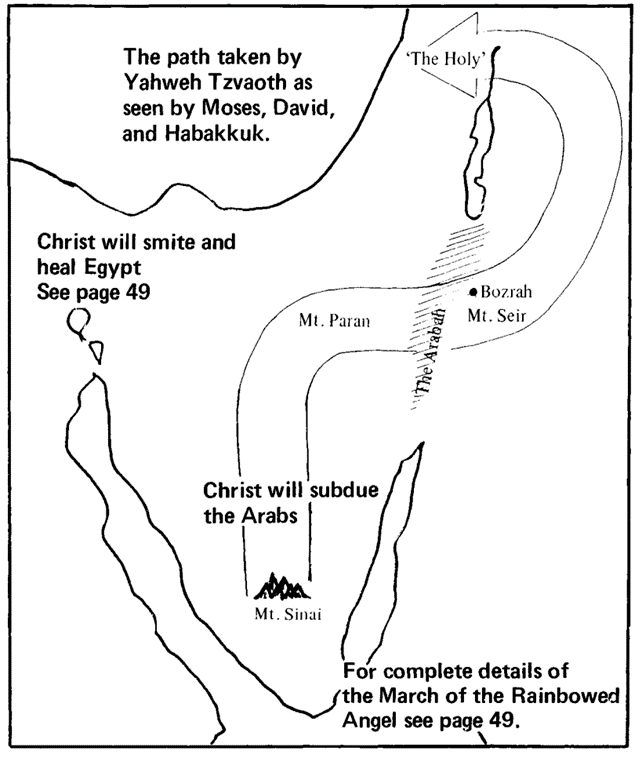
YAHWEH COMES IN FROM SINAI - Deut.33:2-3
V.2 - "Yahweh came from Sinai" - Though much of this chapter is couched in the past tense it is nevertheless evident that Moses is speaking prophetically not historically. Note the unfulfilled prophecy concerning Israel's future security and glory — Vv.26-29.
Yahweh (He who shall be) the prophetic name of Deity which encapsulates His purpose of being glorified in a multitude made like unto Himself, significantly occurs here. It speaks of the multitudinous Christ (Yahweh and all His saints, Zech.l4:5) arising from Sinai to proceed forth on their mission of conquest.
Bro. Thomas translates the phrase, "Yahweh came in from Sinai". The prophecy is couched in the past tense because its fulfilment is guaranteed on the principle of Rom .4:17. Moses saw the multitudinous Christ go forth from the region of Sinai and march by stages to the Land of Promise. Their point of departure being Sinai, it is reasonable to assume that it was the place of judgement and the scene of the glorification of the worthy and faithful saints.
"and rose up from Seir unto them" - The word 'rose up' is ZARACH in the Hebrew signifying to irradiate (or shoot forth beams) i.e. to rise (as the sun). The analogy is that of the sun rising at the dawn of a new day, and travelling over the expanse of heaven. The picture is of Christ, the Sun of Righteousness (Mal.4:2), together with his saints (Matt. 13:43) rising upon the political 'earth' and going forth to dispel its darkness - 2 Thess. 2:8, 1:7-10.
As Christ's entry into the land will be from the east the analogy of the rising sun is very appropriate.
"he shined forth from Mt. Paran" - Again the analogy is that of the sun, now risen high in the sky. The exact location of Mt. Paran is difficult to determine but it was somewhere in the region of Kadesh-Barnea. Christ and his saints are seen moving rapidly across the region of the Sinai Peninsular, northwards, then eastwards and then north again to enter the land from the east.
"and he came with ten thousands of saints" - The word 'came' is ATHAH signifying to arrive, to appear speedily, suddenly, and unexpectedly. This is true of the rising sun. The saints are likened to the rays of the sun shining forth and dispelling the darkness of the political earth. Ten thousand is a symbolic number in scripture representing an innumerable multitude – see 1 Cor.4:15, 14:19, Ps.3:6, Song of Sol.5:10, 1 Sam.29:5, Jude 14. Roth, translates, "Yea he came out of holy myriads". The word 'thousands' is REBABAH - abundance, i.e. a myriad. Moses is speaking not of Israel in the wilderness but of the innumerable company of the redeemed (Rev. 7:9) who "follow the Lamb whithersoever he goeth".
V.4 — "from his right hand' — The symbol of power and authority exercised by the Lord Jesus Christ and his saints — Ps.44:3, 45:4,9.
"a fiery law for them" - Bro. Thomas translates, "a fiery mandate". Roth. - "fire to guide them". The word ESHDATH in the Hebrew means a fire-law. The symbol of fire is frequently used in the context of judgement and it is evident that the law which emanates from Christ's hand has to do with the judgement of the nations.
FROM SINAI INTO THE HOLY PLACE - Psalm 68
V.1 — "Let God arise" - This verse is a direct quotation from Num. 10:35 except that David makes one important change to Moses' words. Each day the movement of the Ark was heralded by the words "Rise up, Yahweh, and let thine enemies be scattered; and let them that hate thee flee before thee". Similarly when the Ark rested Moses said, "Return, Ο Yahweh, unto the many thousands of Israel". Num. 10:33-36.
It is significant that these words are quoted in a Psalm which deals with the bringing up of the Ark to Jerusalem. Both the progress of the Ark from Sinai to Canaan and its installation by David in Jerusalem were highly typical events. The Ark of Israel, the Lord Jesus Christ and its cherubim, the glorified saints will again move from Sinai into Jerusalem.
Hence David substitutes 'Elohim' for 'Yahweh', for then 'he who will become' will be manifested in a multitude of 'mighty ones'. No longer will Yahweh go before the nation and return to it as in the days of Moses but he will be manifested in a host who will bear His name.
V.4 - "extol him that rideth upon the heavens by his name Yah" – Roth. - "that rideth through the waste plains". The word 'heavens' is ARABAH and should read Lit. "through the deserts". This compares beautifully with Deut.33:2 as the Arabah is the arid region south of the Dead Sea, to the east of Paran and in the proximity of Seir.
V.17 - 'The chariots of God are twenty thousand" - Roth. - "The chariots of God are two myriads, thousands repeated". As stated in the notes on Deut.33:2 this is a symbolic number representing an unnumbered multitude - the multitudinous Christ. Chariots are vehicles of warfare (Ps.20:7, Ex. 14:7). These being the 'chariots of Elohim' are symbolic of Christ and the saints in warlike manifestation as the vehicle of Yahweh in His controversy against the nations. It is upon these chariots that He rides through the Arabah, v.4.
"even thousands of angels" - The word 'angels' is SHINAN signifying to change, to reiterate, a repeating. Hence, Roth.— "thousands repeated". Other translations provide the alternative, "the changed ones".
"the Lord is among them, as in Sinai, in the holy place" — Bro. Thomas translates, "The Lord among them, Sinai in the holy". While this is literally correct there are other translations which appear to throw light on David's meaning. In his margin Rotherham quotes Ginsburg who translates,
"the Lord hath come from Sinai into the sanctuary". The Companion Bible has, "Yahweh among them (the chariots and the angels) hath come from Sinai into his sanctuary". The Jerusalem Bible has, "the Lord has left Sinaifor his sanctuary". The word ADONAI should be Yahweh, being one of the changes made by the Sopherim. This beautifully harmonises this verse with verse 4.
The saints are pictured as the cherubic-chariots of Deity amongst whom is found Yahweh (Christ — the Father's namebearer) riding from the precincts of Sinai through the Arabah and into his sanctuary — Jerusalem.
Once again the point of departure for Christ and his saints is Sinai, proving almost conclusively that it is the place of judgement.
V.18 — "Thou hast ascended on high, thou hast led captivity captive" - Paul quotes these words in Eph.4:8 and applies them to the resurrection and glory of Christ, as the guarantee of the resurrection and glorification of his faithful brethren. This confirms the fact that the Psalm deals with things that were beyond the days of David.
ELOAH SHALL COME FROM THE SOUTH - Hab.3:3-4
V.3 - "God came from Teman" - The title of Deity used is Eloah signifying 'the mighty one' and is clearly a reference to Christ. See use of the word in Dan.2:44. Of this mighty one it is said in Hab.3:13, "Thou wentest forth for the salvation of thy people, even for salvation with thine anointed”. The anointed of this verse are the glorified, thus fully anointed saints, (2 Cor.1:21).
Teman simply means the south, i.e. south of Israel or the region of Sinai.
It is important to note that though this verse is in the past tense it should be translated in the future tense, hence Bro. Thomas translates, "Eloah shall come in from the south". The word YAHVO occurs in the text and should read 'shall come in', being in the future tense. That Habakkuk speaks of future events is obvious from the latter half of the verse.
Once again the starting point of Messiah's advance into the land is from the region of Sinai, the place of judgement.
"and the holy one from mount Paran" - Compare these words with Deut. 33:2. The march of Christ and his saints takes them through the region of Paran just south of Kadesh-Barnea.
"His glory covered the heavens, and the earth was full of his praise" - Habakkuk proceeds to the ultimate purpose of the work commenced in Sinai - to fill the earth with Yahweh's glory manifested in Christ and the saints.
V.4 - "And his brightness was as the light" - Roth. - "And a brightness as light appeareth". This parallels with the analogy of the sun found in Deut. 33. Christ and the saints "the kings of the sun's rising" (Rev.16:12) will dawn upon a darkened world like the rays of the sun rising over the horizon at the dawn of a new day.
"he had horns coming out of his hand" - The word 'horns' is QEREN - a horn (as projecting); the word can mean a ray of light. Hence Rotherham translates, "rays out of his hand hath he". The Jerusalem Bible translates, "rays flash from his hands". Again the figure used is that of the sun. The rays or 'horns' which emanate from the hand of the mighty one are symbolic of the saints in glory. Both the horn and the hand are symbols of power, hence
"there was the hiding of his power" - The word 'hiding' is CHEBYOWN signifying a concealment. Thus, the Jerusalem Bible translates, "that is where his power lies hidden". There is another remarkable correlation of ideas here with Deut.33:2 - "From his right hand went a fiery law for them". The saints will be the ministers of judgement to the nations — Ps.149, Jude 14.
The evidence of these three passages of scripture seems quite conclusive. Sinai is the place of judgement, made so by divine decree, historical associations and admirable suitability for the purpose.
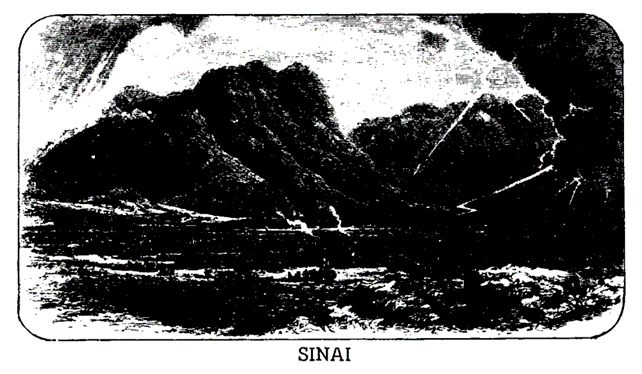
SINAI - THE MOUNTAIN OF JUDGEMENT
The suitability of Sinai as the place of judgement is well described by Bro. H. P. Mansfield in this extract from the Logos Prophetic Supplement (Vol. 36 No. 8).
A place that is isolated, and likely to remain so, is required to permit the secret and uninterrupted communion of Christ with his brethren, following the Judgment (see lsa. 26:20-21).
Sinai is adequately situated for the purpose. It is also rich in historical background so as to provide the solemn significance for such an occasion. It was at Sinai that Moses received his call, and witnessed the miracle of the burning bush. There, also, Yahweh announced His name which is expressive of His covenant with Abraham. At the Mount, Israel was given the law and was constituted the Kingdom or God. To it, Elijah fled from the fury of Jezebel after his dramatic destruction of the priests of Baal and in the storm of hurricane and earthquake, and then in the "still, small voice,'' he was provided with an outstanding apocalypse of divine power and wisdom. At Sinai, most likely, Paul received the revelations that were so awe-inspiring and wonderful, that he was not then permitted to reveal them unto others.
The Sinaitic Peninsula is in the form of a triangle bordered on the one side by the Red Sea, and on the other by the Gulf of Akaba. It is recognised as one of the most mountainous regions of the earth's surface.
Towering, rugged mountains of redgranite are intersected by narrow valleys and desolate plans. Before Horeb is a vast plain at the head of valleys that lead to it, and in which the Israelites camped when they were led there by Moses.
Moses describes the area as "a great and terrible wilderness of fiery serpents, scorpions and drought" (Deut. 8:15). Jeremiah declares that it is "a land of deserts and of pits, a land of drought and of the shadow of death, a land that no man passeth through, and where no man dwelleth" (Jer. 2:6).
The Mount itself is approached through a valley some 200 feet wide, with huge masses of perpendicular granite rocks on either side, which appear as though shattered and split by earthquake. The valley has a gentle, but constant, ascent; the scenery is stern as is appropriate to the use of the site. It proclaims the land of miracles, and its awful isolation and split, eroded rocks seem to suggest the terrors of Yahweh. The scenes are suited to the sounds of the fearful trumpet that was once heard there, and the equally anxious feelings that will be induced by the setting up there of the Judgment Seat of Christ.
Λ Description Of Sinai
The giving of the Law is associated with two peaks". Horeb and Sinai. They form two eminences on the extremes of a plateau some three miles long. It was before Horeb that the people gathered and heard the voice of Yahweh; it was to Sinai that Moses ascended when he spake face to face" with the angel name-bearer. Horeb is some 6,500 feet above sea level (Sinai about 7,500 feet), and about 1.000 feet above the plain. It has a cliff-like appearance, rising precipitously, like a huge altar set in a sanctuary, and is faced by a large plain capable of containing an immense concourse of people. In Sinai and Palestine, Dr. Stanley comments:
"That such a plain should exist at all in front of such a cliff is so remarkable a coincidence with the sacred narrative as to furnish a strong internal argument, not merely of its identity with the scene, but of the scene itself having been described by an eyewitness. The awful and lengthened approach, as to some natural sanctuary, would have been the fittest preparation for the coming scene. The low line of alluvial mounds at the foot of the cliff exactly answers to the 'bounds' which were to keep the people off from 'touching the Mount.' The Plain itself is not broken and uneven and narrowly shut in like almost all others in the range, but presents a long retiring sweep, against which the people could 'remove and stand afar off.' The cliff rising like a huge altar in front of the whole congregation, and visible against the sky in lonely splendour from end to end of the whole plain is the very image of the 'mount that might be touched,' and from which the 'voice' of God might be heard far and wide over the stillness of the plain below, widened at that point to its utmost extent by the confluence of all the continuous valleys."
The experience had a profound effect upon the people of Israel when they gathered there under Moses, so that they entreated with him to intercede for them whilst they retired afar off. How much more awe-inspiring will be our visit to that Mount. Already the power of Yahweh will be visibly manifested in that the majority of the innumerable host then assembled will have been raised from the dead. We will be re-united with loved ones who have died but then will live again.
Each one there assembled will doubtless be impressed by his or her unworthiness for eternal life, and yet bouyed up in the confidence that God is love, and that He has provided an Advocate who knows and understands our feelings, and whose sympathetic consideration will extend the mercy of
forgiveness wherever possible consistent with the justness and righteousness of his Father. Thus the principles of holiness and reverence to the Name of Yahweh will be elevated by all to the glory of the One who proclaimed it.
THE JUDGEMENT SEAT A LITERAL REALITY
Perhaps the most graphic picture of the judgement seat is given by the Judge himself in his parable of the Sheep and the Goats – Matt.25:31-46.
Matthew 25:31-46
V.31 - "When the son of man" - Significantly the Lord uses the title 'son of man'. It was precisely because of his being son of Adam as well as son of God that he is qualified to judge all men - John 5:21-22, 27.
"For we have not an high priest which cannot be touched with the feeling of our infirmities; but was in all points tempted like as we are, yet without sin" (Heb.4:15). Who better to exercise divine judgement?
"and all the holy angels with him" - That the angels will play an important part in our judgement is beyond doubt; therefore, a special section will be devoted to this subject later in these notes.
"then shall he sit upon the throne of his glory" - This throne is clearly not the throne of David which will be the throne of Christ's glory during the Kingdom age but Christ's judgement throne at Sinai. Compare the language used in this verse with the Lord's description of the judgement in Luke 9:26. The Lord presents a vivid picture of a literal throne upon which he himself will sit arrayed in glory and surrounded by his angels who will assist him in the judgement process. It is purifying to mentally contemplate this scene as it will transpire on the plain beneath Mt. Sinai.
V.32 - "And before him shall be gathered all nations" - Some have thought this to be a reference to the judgement of the nations as it is described in Daniel 7. However, the context of Matt.25 clearly has reference to individual responsibility and ultimate judgement. Note the parable of the Ten Virgins and of the Talents and also v.41 and v.46. The reward of the righteous in the case is 'life eternal'; this is certainly not affirmable of the nations who will be summoned before Christ's throne in Jerusalem following Armageddon.
'All nations' is scriptural phraseology for people of all nations. Note Joel 3:11-12, Zech.l4:2; here the reference is to the armies of all nations, not every member of the nations. Similarly, at the judgement there will be present people out of all nations — Acts 15:14, 10:35, Rev.5:9.
"and he shall separate them one from another" - A vivid picture of the Great Shepherd dividing his flock "discerning between the righteous and the wicked", Mal.3:18. An inescapable reality for all responsible men and women! We must all stand before Christ's judgement throne and behold his glory and having given an account of ourselves receive a direction from him - to the right or the left. This is the moment of truth for all. It is conjectural whether this separation will come early or later in the judgement process - what is certain is that the decision is irreversible and the moments spent before our Lord in this scene will be the climax of our entire existence.
"as a shepherd divideth his sheep from the goats" — The very language suggest a preponderance of goats from amongst which the sheep are extracted, thus fulfilling the words, "Many are called but few are chosen". Sheep are chosen to represent faithful and worthy saints because of their characteristics and clearly it is character which Christ will judge — note Vv.34-35.
Sheep are dependent, submissive, willingly obedient and gregarious. All these characteristics will be found in the faithful. Dependence upon the Good Shepherd, humble submission towards God, willing obedience to His will and recognition of their need of fellowship with their brethren.
Goats on the other hand are independent, solitary, disobedient, wilful and callously selfish. These characteristics, or any of them, will disqualify from entrance to the Kingdom. Those who are confident in their own strength, refuse to assist their needy brethren, disobey divine laws, manifest a wilful disposition and callously disregard the needs of others are unfit for a place in God's kingdom.
V.33 - "he shall set the sheep on his right hand" - The right hand, the symbol of power and divine authority is to be the side of reward while the left is reserved for the rejected. Those who pass to the right side will surely echo the words of the Messiah himself, "Thou wilt shew me the path of life; in thy presence is fulness of joy; at thy right hand there are pleasures for evermore" (Ps.16:11).
Having made the division between sheep and goats the Judge then gives his approbation of the faithful and his condemnation of the unfaithful, Vv.34-46.
THE BASIS OF JUDGEMENT - THE WORD
When the responsible stand before the judgement seat of Christ it is clear that the basis of their judgement will be the Word of God - John 12:47-49, Rom.2:12. Christ will be seeking the "fruit of the Spirit", the evidence of a character fashioned by the power of the Word of God, for this alone
will ensure acceptance at the judgement seat — note 2 Tim.3:15 to 4:1. The word of God is a living power and will endure forever, hence those who are manifestations of it and whose lives have been framed and guided by it will also endure forever — Yahweh will not deny His own word — 1 Pet.1: 22-25.
A VERBAL ACCOUNT - Romans 14:10-12
V.10 - "we shall all stand before the judgement seat of Christ" – Should read "judgement seat of God (THEOS)" - R.S.V., Nestle; etc. It is Deity's judgement seat but he has committed all judgement into the hands of his son - John 5:22, 27.
V. 11 - "For it is written" - This verse is a direct quotation from Isa. 45:23. The context of Isaiah speaks of a purified Israel and a humbled world following the judgements Christ is to pour out upon the nations at his return. This is evident also from the other occasion in which the apostle quotes the same words - Phil.2:9-11. While in Philippians Paul applies the prophecy to the triumph of Messiah and his acclamation by the nations, here he applies it to the events associated with the appearance of the responsible before the judgement seat.
"every knee shall bow to me" - This is inclusive of saints at the judgement as well as of all nations.
"and every tongue shall confess to Cod" - In the case of the peoples of the nations this will be a declaration of Yahweh's glory and supremacy and a vindication of the righteous. In the case of the saints it will be the same but on a personal level, during and subsequent to the process of judgement. The word 'confess' is EXOMOLOGEOMAI signifying to speak out the same things, confess fully. An idea of its meaning is gained from its use in Matt. 3:6, Mark 1:5 (confessing), James 5:16, Rev.3:5 (confess).
The use of the voice is clearly intended.
V.12 - "every one of us shall give account of himself to God" – The word 'account' is LOGOS (the word spoken; an expression of the thoughts of the mind). In this context LOGOS signifies the word as that which is spoken, an exposition or account which one gives. All who are responsible will give a verbal account before Deity which will expose their character and reveal their conduct during probation. It is possible that a full review of our lives will be made in the presence of the angels and that we will then appear before Christ for his final judgement which by then the discerning will have anticipated.
THE PLACE OF THE ANGELS AT THE JUDGEMENT
The angels will play an active and important part in the judgement of the household and the development of Yahweh Tz'vaoth (He who shall become armies) or the Multitudinous Christ who will then relieve them from their duties for the duration of the Millennium — Heb.2:5.
1. The angels will accompany Christ when he returns as Judge — Matt.16:27, 25:31, Mark 8:38.
2. The results of the judgement will be declared in the presence of the angels - Luke 12:8-9, Rev.3:5.
3. The angels will be involved in the removal and punishment of the unworthy - Matt.13:49-50.
THE ANGELS AS MINISTERS TO THE SAINTS
That the angels will be involved in the judgement of the saints is particularly appropriate in view of their close involvement with those saints during their probation. The scriptures teach that Yahweh appoints an angel to minister to and overshadow those who become heirs of salvation – Heb. 1:14, Ps.34:7, 1 Tim.5:21.
Hebrews 1:14
"Are they not all ministering spirits" - The word 'ministering' is LITOURGIKOS signifying that which pertains to the public service, esp. of the Temple. This is a most appropriate word for the work of the angels, for they are indeed servants for the general good and well-being of 'a Temple'
- the Temple of the living God composed of living stones; the Ecclesia.
They are 'spirits' or immortal messengers.
Roth. — "Are they not all spirits doing public service - for ministry sent forth for the sake of them who are about to inherit salvation".
"sent forth to minister" - The Greek for the words 'sent forth' is APOSTELLO - to send forth, equip and despatch upon a certain mission. That mission is to 'minister' - Greek EIS DIAKONIA - Lit. with a view to service. The task of the angels is to serve those who are the heirs of salvation. This is a remarkable and sobering fact in itself and should provide a greater sensitivity to divine things, but there is the added fact that the position of the angels in relation to the saints admirably fits them for the work of judgement.
It also appears from a number of scriptural passages that each individual saint has one particular angel who is appointed to minister to him – Gen. 48:16, Matt. 18:10, Acts 12:15.
Sometimes the word 'angels' in Acts 12:15 is interpreted as simply meaning a messenger. This is one explanation which is satisfactory, but it does not ring as true as the alternative interpretation in view of the absolute incredulousness of the disciples in the house of John Mark. The damsel Rhoda insisted that it was Peter's voice that she heard at the door and that there was no mistake. In the face of this insistence only one thing seemed feasible - divine intervention - it must be Peter's angel! It is
interesting to note that Peter's angel was instrumental in releasing him from prison - Acts 12:7-10.
THE BOOKS OF JUDGEMENT
The scriptures speak of two books that will be involved in the destiny of every responsible person. They are: —
1. A book of the Life
2. The Book of Life
The latter is frequently referred to by that name while the former is alluded to in a number of passages which will be considered in these notes.
Are the Books literal or figurative?
The question as to whether the books of judgement are literal or figurative is unlikely to be finally resolved until the day of judgement when the answer one way or the other will not be of great significance to those passing through the judgement process. It is now that we can gain value from making the effort to determine an answer from the evidence of scripture for ourselves, and being fully persuaded in our own mind, use that knowledge to stimulate and strengthen our faith so that what is recorded in those books will be a cause of joy for us in the day of account.
While it is manifestly obvious that Yahweh, whose knowledge and memory know no bounds, is not in need of a book to record the names of the saints or the events of their lives, a good deal of evidence seems to point to there being literal books for this purpose. Deity in His infinite wisdom does not require written records in order to remember, but finite and fickle man is not in that position. May it not be that God could adopt a method of recording the lives and names of His servants, which though unnecessary to Himself is to the advantage and consolation of His children. Certainly the expressions used in relation to the books of judgement imply the existence of literal books, whether they actually exist or not.
The conviction that there is a book in which our names have been written is a cause of great joy to faithful disciples of Christ (Luke 10:20), while the knowledge that all our ways and actions are recorded in another book is a compelling influence towards constancy and stedfastness in living the Truth in daily life.
Some evidence for literal books
Fistly, it is interesting to note that the word for 'book’ in Hebrew is CIPHRAH meaning a writing, by imp. a book, while the word in the Greek is BIBLOS signifying a written book, roll, or volume.
Moses evidently believed that there was a literal Book of Life. This is the clear implication from Ex.32:32. The word 'written' is KATHAB and means to grave; to write. It is the same word as is used in Dan. 12:1 which also implies the existence of an actual book. (Note the way KATHAB is used in Ex.31:18, 32:15, and Dan.9:13).
In the N.T. there is also evidence for a literal Book of Life. The Lord said to his disciples, "Rejoice, because your names are written in heaven", Luke 10:20. The word 'written' in the Greek is said by the better texts to be EGGEGRAPTAI signifying to inscribe or enroll. Hence Nestle - "have been enrolled".
A BOOK OF THE LIFE
This is a kind of 'day book' in which the daily lives of the saints are recorded, event for event through the trials, tribulations, triumphs, failures, sins, and acts of righteousness that occur. By this means the growth and development of character is carefully traced throughout our probation. At either the death of the saint or at the return of Christ the account will be taken and the divine decision made as to whether or not the saint will have his name left inscribed in the Book of Life. Both books will appear at the judgement seat of Christ. The 'day book' to review the life and probation of each saint will most likely be used by the angel appointed to minister to him, while the Book of Life will be used by Christ to pass final judgement.
The following passages refer to a daily account or a book of the Life.
Psalm 56:8
"Thou tellest my wanderings" - Roth. - "My wanderings hast thou recorded". The word 'tellest' is CAPHAR; to score with a mark as a tally or record, i.e. to inscribe.
"are they not in thy book" - CIPHRAH from CAPHAR, meaning a writing or record. As this is not the Book of Life in which are recorded names it must refer to another record - an individual account of the Psalmist's life.
Where sins recorded therein have subsequently been forgiven, they will be blotted out of the record entirely (Isa.43:25).
Malachi 3:16
“and a book of remembrance" - The Hebrew word for 'book' is again CIPHRAH - a writing or record. The word 'remembrance' is ZIKROWN - a memento, from the root ZAKAR - to mark; i.e. to remember. This could well be a reference to a daily record of remembrance as well as a record of identity.
"was written before him " - This language clearly implies that someone wrote the record for Yahweh. Only His angels could perform that task at the time of this prophecy. It was a practice of monarchs of the times to record the history of their reigns and to note the acts of their servants -
Esther 6:1. Unlike earthly monarchs Yahweh does not require a record of past history in order to review distant events, but evidently has chosen to keep such a record of the lives of His saints for their present and ultimate benefit.
The use of the word KATHAB - to grave, to write, once again strongly suggests an actual record.
Revelation 20:12
"And I saw the dead" - These are the mortals who have died during the Millennium and are raised at the second resurrection to face judgement at the end of Christ's 1000 year reign. As the second resurrection and judgement will be a repetition in format and aim of the first, we may conclude that the methods used to dispense judgement are also the same.
"stand before God" - Christ will be the judge, he being the manifestation and representative of Deity.
"and the books were opened" - These books (plural) are quite distinct from the Book of Life which is next mentioned as a singular record. Clearly a daily account of each individual's life will be kept and out of these records they will be judged.
"according to their works" - Their 'works' or deeds are what is recorded in the books as these constitute an indication of character.
THE BOOK OF LIFE
This is a record of those who will enter into eternal life. The names of all saints are recorded at the time of their baptism, i.e. the beginning of their probation - Luke 10:20, Phil.4:3.
The name remains in the book as long as the life of the saint is worthy of perpetuation eternally, otherwise it is "blotted out" - Rev.3:5, Ex.32:32-33, Ps.69:28.
At the judgement only those whose names appear in the Book of Life will be granted immortality - Dan.12:1, Rev.21:27, 20:15.
REAPING WHAT WE SOW
Those who have devoted their lives to the fulfilling of fleshly desires will in the end reap of the flesh the only thing it can offer — corruption. On the other hand, those who have devoted their lives to spiritual pursuits will in the end reap of the Spirit life everlasting - Gal.6:8.
The apostle elsewhere termed it "receiving in body" the things done, whether good or evil - 2 Cor.5:10.
2 Corinthians 5:10
"we must all appear" - Paul uses the word PHANEROO - to make apparent, show forth, which is twice rendered 'made manifest’ in the next verse (v.11), to emphasise that we will receive bodily what we have done.
"that every one may receive the things done in his body" - It will be noted that the words 'done' and 'his' are in italics in the A.V. and therefore should be deleted to give the proper sense.
Rotherham's translation of this verse is interesting and captures the true sense; "For we all must needs be made manifest before the judgement seat of Christ, that each one may get back the things done by means of the body, according to the things which he practised, whether good or corrupt". We shall receive in body the reward or punishment due according to that which we have done. The wages of sin is death or corruption but the gift of God is eternal life - Rom.6:23.
CHILDREN AT THE JUDGEMENT SEAT
The children of saints are "an heritage of Yahweh; and the fruit of the womb is his reward", Ps. 127:3. This being the case it is certain that the Father will provide an arrangement for the present and future well-being of children whose parents are called to the judgement seat. Neither the
Father or His son are indifferent to the concerns and feelings of parents, and it is likely that children will accompany their parents in family groups to the precincts of Sinai where they will continue to receive care and education both during and subsequent to the judgement in order to prepare them for their place in the Kingdom as mortal subjects of Christ.
In the Ambassador Vol.3 page 185 Brother Roberts commented on this subject as follows: "As to children who may be alive when the Lord returns and sends for the members of his household the question is, will not provision be made for the household of the faithful? If we are to judge from the Deity's operations in the past, we are justified in expecting that this will be so. Respect has always been shewn to the kindred of those who have been the objects of divine regard. Noah's family is one instance; Lot's family another. His sons-in-law were, by command of the angels, invited to escape the impending judgement, but laughed the invitation to scorn. Rahab's family were spared from the destruction that befell Jericho. Is it not possible that similar favour will be shewn when the greatest judgement of all arrives? Is it not possible that households may be invited to accompany the saints eastward? As a matter of course, the saints alone are called to judgement, and they alone enter the Kingdom of God, in the sense of obtaining the life, honour, and glory of it; but mortal subjects will have to be provided for as well as kings and priests; and is it not possible the saints may have a commission to secure among these a place for such of their kindred as shall have to leave home and country for the seat of the New Power, there to shelter in the King's refuge until the judgement is overpast, and afterwards to settle among the tribes of Israel as strangers sojourning in the Land, to whom a portion will be divided? (Ezek.47:22). If so all difficulty about the children would be at an end."
The passage from Ezek.47:22-23 referred to by Bro. Roberts bears closer examination as it provides the key to the future of the children of parents called to judgement.
Ezekiel 47:22-23
V.22 - "ye shall divide it by lot for an inheritance" - The context concerns the division of the Land of Promise amongst the restored and purified tribes of Israel in the age to come. The area divided to each tribe will then be further divided amongst the families of that tribe.
"to the strangers that sojourn among you" — The strangers are foreigners or Gentiles by origin. However, they are not ordinary Gentiles but a privileged class, as they are to be considered "as born in the country among the children of Israel". Furthermore, they will inherit equally in the Land with other natural born Israelites. Only a special class would be given such opportunities.
It is evident that these 'strangers' are the children of saints who had not reached the age of responsibility at Christ's return. They would by then be mature adults with families of their own, having been raised through the dramatic period of Christ's subjugation of the nations and his preparations for the Kingdom age. During this time they will have been well educated in the things of the Truth and will have accepted it in the appropriate manner. In fact more will be required of them than the Gentiles outside the Land. Not only must they be circumcised in heart (the principle of baptism) but also in flesh — Ezek.44:9.
As mortals they will live out their probation in the Land under the guidance of Christ and his saints in preparation for their ultimate acceptance into immortality at the second resurrection and judgement.
Two Questions Considered
Two questions naturally occur as a result of such a consideration as this.
They are: —
1. What of the children whose parents are rejected at the judgement seat?
2. What is the age of responsibility and what will happen to those who have reached it but have not been baptised at Christ's return?
The following is an attempt to supply a scriptural answer to these two questions.
Question 1. — The over-riding principle in all cases that might be raised is, "Shall not the Judge of all the earth do right", Gen. 18:25. Where parents have turned their backs on the Truth and lived ungodly lives, and their children have followed their example it is certain that both parents and children will be banished from Christ's presence. This was the principle adopted in the case of the Canaanites who inhabited the Land of Promise, Deut.20:16-18. The reason for destroying the children along with their adults was that having been educated in their parent's evil ways they would eventually grow up and practise the same evils.
If however, children have shown an interest in the things of the Truth despite their parent's indifference, it is certain that they will receive an opportunity to accept the Truth by being preserved from the judgement that will befall their parents. This is amply illustrated in the case of Korah and his children - Num.26:9-11.
The children of Korah evidently dissociated themselves from their father's rebellion and were spared from the judgement poured out upon the rebels and their families.
Children whose parents are rejected in such a case may well be cared for and educated in spiritual things by immortal foster parents until they attain to maturity. Perhaps these children will grow up in the company of the children of Israelites who survive Armageddon, and be found playing "in the streets of Jerusalem", Zech.8:4-5.
In the plan of Deity 50 years will pass between the return of Christ and the opening of the Millennium, thus a child born just prior to the return will be over 50 when the Millennial Age dawns and will be able to take his place among the restored tribes of Israel.
Question 2. - In the wilderness the age of responsibility appears to have been "from twenty years old and upward". At least all who had attained that age were condemned to die in the wilderness - Num.14:29. Twenty was also the age at which the payment of half a shekel had to be made (Ex.30:14) and also the age at which a young man entered Israel's military forces (Num.1:3). However, it would be dangerous to suggest that a fixed age determines responsibility to divine judgement. Responsibility results from knowledge, not age, and it is absolutely certain that any young person under twenty who has acquired sufficient knowledge to enlighten them as to what is required of them but have deliberately delayed answering the call of the Truth or have ignored it altogether, will be called upon to give an account at the judgement seat as to why they did so and will face inevitable and outright rejection. Such will be given no opportunity to live as mortals during the Kingdom Age.
Responsibility then, is predicated upon knowledge and this may come well before 20 as it did to Robert Roberts who was baptised at the age of 14.
What then of those young people who having reached an age when they are beginning to appreciate the message of the Truth and can see the need to grow in knowledge so that they might accept it, but are prevented from doing so by the intervention of the return of Christ?
There is no doubt that such children will receive merciful consideration by Christ. Not having attained sufficient knowledge to be considered responsible to judgement they will be given opportunity to continue their education in the things of the Truth and will live out their probation as mortals in the Kingdom Age. The key to their future well-being is their interest in the things of the Truth manifested by their keen involvement in such things as Sunday School work, but above all by a willing submission to their parent's guidance and instruction. The disinterested and disobedient child is not likely to be regarded as suitable for a privileged position among mortals in the Kingdom Age.
For those who have come to sufficient knowledge to make them accountable for their actions but are prevented by time from being baptised (e.g. the Lord may return the very week or day that they are due to be baptised!), it is certain that their intentions will be taken into account by the Judge. The God of heaven and earth says of Himself, "I Yahweh search the heart, I try the reins, even to give every man according to his ways, and according to the fruit of his doings" (Jer.17:10). Knowing the heart of his children, Yahweh will provide a way into immortality for those who have diligently sought Him and earnestly desired to make a covenant with Him by sacrifice in the waters of baptism, but were prevented from doing so by things beyond their control. The case is illustrated by the promise of Christ to the repentant thief on the cross - Luke 23: 42-43.
The Judge of all the earth will do right in such cases. He will perceive the genuine and divide them from the dilatory and deceitful.
THE RESPONSIBILITY OF PARENTS AND CHILDREN
A great responsibility devolves upon parents to educate their children in the things of the Truth from the earliest possible age that they might be prepared for reception by Christ as privileged mortals in the Kingdom Age. It is an apostolic commandment to bring up children "in the nurture (Gr. - education and discipline) and admonition (Gr. - instruction) of the Lord", Eph.6:4. To neglect the education, discipline and instruction of our children may cost them their lives eternally.
Children must also respond to their parent's guidance for it will be a critical factor in their acceptance by Christ as his mortal subjects in the age to come. Paul commanded, "Children, obey your parents in the Lord", Eph.6:1, and it is certain that children who disregard this injunction will not be considered suitable to be given opportunity for mortal probation in the Kingdom Age. In a similar way as the wife is to regard her husband as her head; the representative of Christ, so children should regard their father as being in God's stead, until they reach an age of responsibility to their Father in heaven. If children cannot obey their earthly fathers (providing of course, that their father merits obedience) then how can they render obedience to their Father in heaven whom they cannot see.
It is the wisdom of children to submit to parental guidance, instruction, and discipline even when occasional inadequacies and mistakes may be discerned in their parents. Children should accept that their parents have as their primary object the eternal well-being of their off-spring and though they may make some mistakes in the course of fulfilling their difficult duty, the end result can only be to the eternal advantage of the child. This submission should continue until 'a man leaves his father and mother and cleaves unto his wife'. The modern trend of leaving home at an early age to escape parental control bespeaks the fulfillment of Paul's prophecy that the latter days would be characterised by a breakdown in family life with men being "disobedient to parents" - 2 Tim.3:2. Sadly, the same problem is today evident within the Brotherhood of Christ.
Children should demonstrate their obedience and submission to their parents by a willingness to join in the reading and study of the Word in the home, by attending and fulfilling work associated with Sunday School and by sharing ecclesial life with their parents as age and opportunity permit.
Children who do this will not be disappointed should the Lord return before they attain to maturity and responsibility; they will live as privileged mortals during the Kingdom Age.
CHILDREN 'HOLY'
In 1 Cor.7:14 the apostle says, "For the unbelieving husband is sanctified by the wife, and the unbelieving wife is sanctified by the husband: else were your children unclean; but now are they holy”
Some regard this passage as merely demonstrating that a marriage contracted by two unbelievers is validated by the entry of one party into the Truth despite a past history of divorce and other disqualifying factors which would preclude remarriage for those within the Brotherhood. It is said also that any children born to a union before either party entered the Truth would be regarded as legitimate despite their birth under what would be regarded as adulterous circumstances within the Brotherhood.
However, there appears to be more in Paul's words than this. A closer examination of the words used seems to reveal that children of Christadelphian parents enjoy a special status in the sight of Yahweh.
1 Corinthians 7:14
"sanctified" - HAGIAZO - to sanctify, to make holy, to set in a state opposed to that which is common or unclean.
"unclean" - AKATHARTOS - unclean, impure, unpurified.
"holy" - HAGIOS - holy, sacred.
Rotherham translates — "For the husband that believeth not is hallowed in the wife, and the wife that believeth not is hallowed in the brother. Else were the children impure, but now are they pure."
The apostle quite definitely is dealing with the changed status of the marriage union by association with the Truth but in so saying seems to imply that the sanctification of one party in the Truth encompasses the other partner and their off-spring. The implication is that Christadelphian child-ren enjoy a unique status — they are holy unto Yahweh. This is consistent with the purpose He has in store for them.
WHY THE PERIOD OF JUDGEMENT WILL BE SHORT
Earlier in these notes it was postulated that a period of 10 years will be consumed between the return of Christ and the battle of Armageddon. Will the whole 10 years be taken up by the judgement of the household? Certainly not. There are many things to be performed by Christ in this 10 year period as the notes will go on to show.
It is certain that the period of judgement will be relatively short, for to extend it over a period of many years would be an intolerable burden upon those waiting for Christ's verdict. There have been a number of suggestions as to how the Lord will remove the anxiety of his servants as they await their call to stand before him. We mention two that are worthy of consideration.
Suggestion 1. - The angels will gather the responsible to Mt. Sinai and will undertake a review of each individual's life, by the end of which it will be obvious which way Christ's verdict will go. They will then await their call to stand before him, probably in groups, and will receive his decision.
Suggestion 2. - The angels will convey the responsible to the judgement seat and usher them immediately into Christ's presence. The Judge will separate the just from the unjust and the two groups will then await their time to give a personal account and receive their reward or punishment.
We prefer the first suggestion because it will remove the anxiety of waiting for an indication of our destiny while still allowing time for the true characters of the just and unjust to be revealed in the presence of Christ.
The just will be absolutely humbled by a review of their lives in the presence of their angel. While their failings will be fully manifest it will also be clear that their life and character is approved by Christ. As they wait to stand before Christ and receive his verdict their sense of unworthiness will struggle with the euphoria associated with the indications of their acceptance, producing a grateful humility in which any feelings of self-importance will be completely absent. Open and uninhibited joy must wait until the final verdict is delivered by the Judge.
On the other hand, the unjust having had their lives reviewed by the angelic minister with clear indication of their unworthiness and pending rejection being given, will retire bewildered or resigned to their fate. In the case of those who were confident of acceptance but who now see the probability of rejection looming, there will be a time of reflection in which they will collect together a list of all their 'good works' which they will present to Christ in the indignant spirit of those mentioned in Matt.7:22-23, and Luke 13:26-27.
Finally, all will have passed before Christ and will have turned either to his right or to his left to stand amongst the 'sheep' or the 'goats' to receive the reward or punishment due - Matt.25:3146. Then all shall be publicly revealed or 'made manifest' for what they are - see Rotherham's translation of 2 Cor.5:10.
The purpose of the judgement will have been accomplished. The Lord "will bring to light the hidden things of darkness, and make manifest the counsels of the hearts", 1 Cor.4:5. The faithful will have been completely humbled before their exaltation and the unfaithful will be revealed for what they are - self-centred and proud.
If this suggestion is correct then the period of judgement will not need to be of great length despite the myriads who must appear at the tribunal of Christ.
THE FATE OF THE REJECTED
This may be a negative subject but quite a deal is revealed concerning the punishment of the wicked and rejected in scripture as a warning of the consequences of unfaithfulness and disregard towards the things of the Truth. A brief consideration of some of these things can only be to our advantage.
1. Shame (Dan.12:2), tribulation, anguish and wrath (Rom.2:8-9), weeping and gnashing of teeth (Matt.8:12) is the lot of the rejected.
2. Punishment will be meted out in degrees according to the principle of Luke 12:47-48.
3. The wicked will have their shame revealed before their brethren (Rev. 16:15, Luke 12:3.)
4. They will depart from Christ fearfully looking for the inevitable judgement, Heb.10:27.
5. The punishment of the rejected will be suffered amongst the nations described parabolically as "outer darkness" — Matt.22:13. Possibly those who are alive and remain at Christ's return will have to endure the shame of returning to their home to experience the ridicule of their neighbours and acquaintances. The terror for those rejected out of past generations being cast out into the modern world then in complete turmoil can easily be imagined.
Suffice it to add a passage from Nazareth Revisited pages 393-4 by Robert Roberts:
A man dismissed from the judgment seat first suffers the agony of having his shame " seen " (Rev. 16 : 15). He is publicly condemned in the presence of fellow-servants and a multitude of the angelic host (Rev. 3 : 5, 9 ; Luke 12 : 8). Next, he departs, but not whither he wills. He might choose to bury himself in the forests, or wander wide o'er earth or ocean, or find refuge in death. The sentence orders his expulsion to the " outer darkness " which still reigns in the world for a while after Christ's return. In this outer darkness, the world of the ungodly, organized as " the devil and his angels, 0 alias " the beast, and the kings of the earth, and their armies " (Rev. 19 : 19), is marshalling its forces for "the war of the great day of God Almighty," in which they "make war with the Lamb, but the Lamb shall overcome them." Fierce judgment impends at that moment, of which the world is unconscious. Christ, of whose presence they are not aware, is about to be manifested "in flaming fire taking vengeance" (2 Thess. 1: 7, 8).
The sentence of expulsion consigns its unhappy objects t participation in "the judgment and fiery indignation which shall devour the adversaries" (Heb. 10 : 27). Their fate is to "depart from me ye cursed, into the aionian fire prepared for the devil and his angels." Into the countries of the condemned, the whole multitude of the rejected will be driven to shift for themselves among a cruel population for whom judgment waits. Mortal as they are, it is no stretch of the imagination to realize the suffering of body, the anguish of mind incidental to such a fearful situation— without home or friends or acquaintances or means of living, wandering as vagabonds like Cain, till the maturing judgment of God culminates in the terrible outbreak of destruction and desolation long
foretold. This "hour of judgment" will take time to run. The "few stripes" will probably be exemplified in the shortening of the term of suffering. Such will die before the worst comes. "Many stripes" will be seen in the case of those wretched children of disobedience who will be preserved through all the terrors of "the time of trouble such as never was," and survive to be engulfed in the finishing strokes of judgment by which wickedness will be finally overthrown, and the way cleared for the Kingdom of God.
THE CONDITION OF THE WORLD AT THIS TIME
Some indication is given in the above extract of the state of the world while the judgement is in progress at Sinai. The "light of the world" (Matt.5:14) having been withdrawn, the world will descend into total darkness as intense as that which fell upon the land of Egypt at the behest of Moses - Isa.60:2.
Politically, the world will be in absolute turmoil (Luke 21:25-28) as nations talk of peace (1 Thess.5:3) but feverishly prepare for war (Joel 3:9-11).
Every last vestige of moral restraint will be abandoned as the world plunges into a state likened to the days of Noah and Lot - the earth will be filled with violence and moral corruption — Luke 17:26-29.